Archives For November 30, 1999

I traveled to Abilene for ACU Summit this week – a ministry conference geared for the tribe of my youth, Churches of Christ. The main reason I came was because the resource group I work with, Mission Alive, hosted a Celebration on Monday night where we tell the stories of mission and discipleship from the front lines of the kingdom for those who are interested to hear and partner.

I’ve also had the opportunity to reconnect to old friends all over the nation who are pursuing God’s calling for their lives. Some are worship ministers. Others are preaching ministers. Still others are missionaries and church planters. It’s exciting to see what God is doing through them.

But I’ll be honest – coming to events like these is always a challenge for me on some level.

Part of it is the temptation for comparison. How am I doing compared to that person? How is the church I’m leading doing compared to the church that person is leading?

Another part of it is my vocation and calling. I was groomed to be a preaching minister. Yet God called me into church planting and missionary work. Granted, I do preach, and I enjoy it – but because I’m a missionary and work with a small church I do many other things as well – many of which I enjoy as much or more than preaching. So I’m not really a Preaching Minister (capitals intentional). Admittedly, there’s a sense of loss there for me because I don’t fit in with my preaching buddies the way I would if I was a Preaching Minister.

Enough about me. That just gives you a backdrop for what I really want to share.

I realized something in the midst of this internal dialogue I’ve had here at Summit that I was not able to realize a couple years ago.

This is an identity problem.

And it has a lot to do with the gospel.
Continue Reading…

In the last post, I described a gap we’ve discovered in our relationships with non-Christians. In summary, we have focused on helping our friends belong with us to the neglect of helping them believe with us.

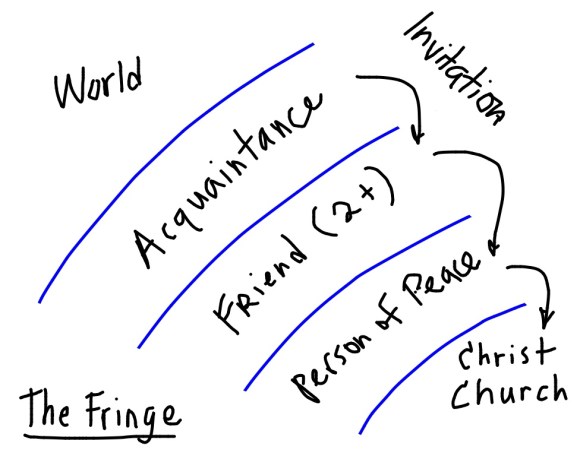
Ken Primrose from Norman Community Church introduced me to a concept he calls “The Fringe” that I’ve found very helpful for discerning how to bridge the gap in our community.

The Fringe is the social space between the Christian community and those who are not part of it.

In this process, there are three basic stages of relationship for a non-Christian on their journey to Christ and into Christian community. People certainly come to faith in other ways. The Fringe seems particularly helpful for communities who work out of a “belong then believe” paradigm and want to be intentional about it.

Continue Reading…

When I got into church planting, I wanted to do evangelism differently.

Most of the churches I’ve been a part of had a “believe then belong” paradigm for evangelism. In other words, after a person believes in the gospel and gives their life to Jesus then they can belong to the church – that is, participate in ministry, be a full-fledged member of the community, etc.

Even if this paradigm isn’t voiced in churches, non-Christian newcomers can sense it. One doesn’t fully belong until one becomes a Christian. Which makes sense to a certain degree – it is a Christian community, after all.

Practically speaking, evangelistic Bible studies are the front door of interaction with non-Christians in this paradigm. A couple years ago one Christian participant of Storyline observed all the non-Christians hanging out with us at parties and gatherings and asked me why we didn’t have more Bible studies going on with them. She had grown up in the “believe then belong” paradigm.

I was, however, smitten with an alternative paradigm to evangelism – “belong then believe” – articulated by people like George Hunter, Brian McLaren, Will Willimon and Stanley Hauerwas. Non-Christians come to faith by belonging first to a community of believers – participating in ministry, knowing others deeply and being known deeply – and then discover that in the midst of it all they believe!

Continue Reading…

I had a great lunch with a fellow church planter Kendon Greene last week. We both share a partnering church in The Hills Church of Christ.
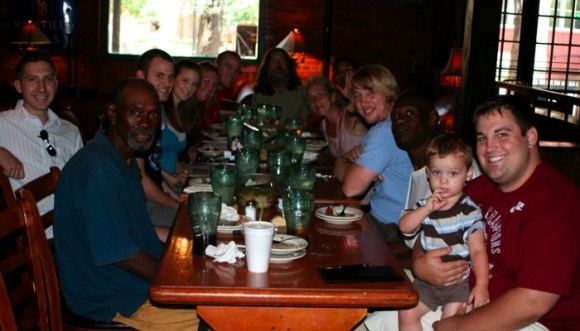
Kendon is planting Unity Christian Fellowship (UCF) in Arlington, Texas. He described his church’s journey from serving an affluent upper class group to being a church of and for the poor.

Two things he said really stuck out to me about their ministry to and with the poor:

1. “I don’t know what the poor need.” Kendon and UCF have stopped making assumptions about how they can help their poor neighbors and started asking them instead for the answers. One woman they served told them: “I’ve got a shelter to go to at night, but those guys over at the park – they don’t have anything. You should help them.” That comment led to some breakthrough for UCF after they started taking cold bottled water to the homeless people who lived around the local park and hanging out with them. Several of the friends they made at the park have become part of UCF group as a result.

Continue Reading…

This summer the Storyline House Church I’m part of decided to resurrect “Neighbors Lunch” ministry like we did in the “early days” of Storyline (because we’re so old now).

Storyline’s first Neighbors Lunch in June 2008.


The idea initially came to us from Luke 14, where Jesus says something like: “If you’re going to throw a party, don’t invite your rich friends who can repay you. Instead invite the lame, the crippled and the poor. They can’t pay you back so God will have to be the one to reward you.”

We began to wonder: what if we took Jesus seriously and actually did that? I have found that those who ask this question are typically on the cusp of a transformative experience. That’s certainly been the case for us.

Continue Reading…