We want Storyline to be a community that works for justice.
Part of the reason we decided for a context in the city was because of its proximity to poverty and injustice. We wanted to be close enough to serve and love oppressed people, and even stand up for what was right before the powers that be.
We know that much. That much, in fact, has come to us pretty easily.
Discovering how to go about being that kind of community has been a much more difficult process.
I read somewhere recently about a distinction Brian McLaren made between justice and mercy. He said that mercy is caring for people who were made sick, for instance, when they drank polluted water from a nearby stream.
Working for justice, on the other hand, is going upstream to see who polluted the water and getting them to stop.
I love the analogy of the river. We’d do well to translate it into other contemporary metaphors of injustice.
McLaren’s definition of justice, however, seems to put forward a false distinction between justice and mercy. Justice in the Hebrew prophets seems to be both confrontational and merciful. Working for justice to “roll down like a river,” in Amos’ words, was both to uproot unjust rulers and to care for those in poverty.
To work for justice is both to care for people made sick by polluted water and also to stop the people who are polluting the water.
Here’s a million dollar question I’m wrestling with: what does it look like for Storyline to work for both facets of justice in a way that’s consistent with our values and style?
Last year I attended the National New Church Conference (aka Exponential) and listened to David Mills talk about conducting a “community needs assessment.”
The needs assessment entails networking with and interviewing social service organizations in the community for the sake of discerning deeper needs. Mills even suggested forming a separate nonprofit organization that would one day fill a niche in the community discovered by the needs assessment process.
I loved the idea and began to pursue it. But as I talked with my friends in Dallas who work in social services and community development, the idea didn’t gain much traction.
It began not to sit well with me either, but I could not put my finger on why.
Then it dawned on me: a needs assessment process and the development of a separate nonprofit for justice is an institutional way of working for justice.
It starts at the top — discerning needs from those who work with people in poverty, rather than discerning needs by serving and living among people at the bottom in a grassroots, relational way.
What would it look like to translate yet another institutional paradigm for ministry into a more organic one?
Perhaps we start by asking our Storyline people who live among the poor what needs they see in the lives of their neighbors. Then we seek to enter into relationship with them and serve them.
Perhaps we adopt their neighborhoods and even one day move into them.
Perhaps our justice ministry is not centralized but rather localized within our house churches such that each works for justice in ways that connect to its particular passions, gifts, neighbors and neighborhoods.
We’ll network with social service organizations not to discern needs but rather to ask for help with the needs we’re discovering because we’re involved relationally in the lives of hurting people.
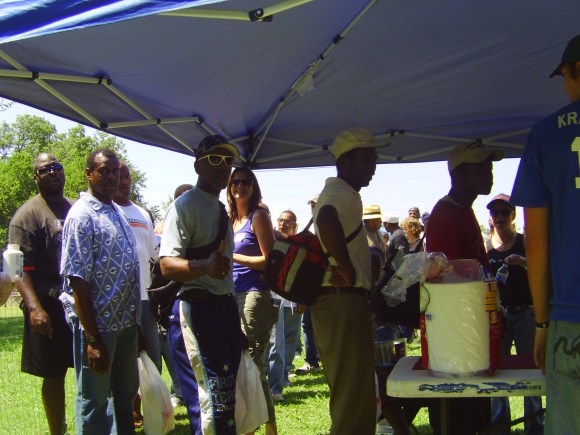
These kinds of things are already happening within each house church in the Storyline Community, despite my sluggishness. The jobless are getting help with networking and resume development. Those on the cusp of being evicted are getting rent assistance from grassroots collections in the community. Those who need groceries for the week are getting them.
It seems I am, as always, one step behind what God is already doing.
When the time comes, as we’re in the thick of loving and serving people in such ways, house churches will begin to sniff out the larger, systemic forces that oppress our neighbors.
So we’ll collaborate with our friends in social services and community development and begin to bark and lay our lives on the line until things change on a systemic level.
God, of course, will be the one with the power to change systems of such scope.
What do you think of all this crazy talk? Help me translate. What would it look like for churches to work for justice in more organic ways?









 In the Storyline