Archives For November 30, 1999

Part one addressed how Storyline is changing in its approach to discipleship. Part two addressed how Storyline is changing structurally. This final post in this series addresses how Storyline is changing in regard to starting new churches and training church planters.

My calling into church planting is not to plant a single church. It’s to participate in a church planting movement.

That’s what attracted me to the leaders of Mission Alive, our church planting resource organization, whose dream is to facilitate church planting movements all over North America.

And that’s why reproduction has been programmed into the DNA of the Storyline Community. Reproduction is one way we practice mission: reproducing followers of Jesus; reproducing churches in our network; and reproducing communities that will live a similar missional existence in a different locale.

In the fall of 2010, Storyline got its first taste of starting new churches when we sent Micah and Amy Lewis to Wichita, Kansas, to start a new church in downtown Wichita. They were sent after an 18-month period of training with Storyline and are partnering with the RiverWalk Church in Wichita. Storyline continues to support them financially through the Mission Alive Harvest Fund and through monthly contributions. I also serve as a church planting coach for Micah.

One thing I learned through this experience: a church doesn’t have to have all of its ducks in a row to be a church planting church.

  • A church planting church doesn’t have to be an established, mature congregation. (Storyline is not.)
  • A church planting church doesn’t have to have a sizable annual budget with significant financial resources. (Storyline does not.)
  • A church planting church doesn’t have to have all the training and equipping resources within itself. (Storyline does not.)

That’s the great thing about the kingdom: the power of partnership — the power of collaboration (another one of Storyline’s values).

In the kingdom, young churches like Storyline can partner together with established churches like RiverWalk in Wichita — which have significant financial resources among other things. Young churches can partner with resource organizations like Mission Alive — which has well-developed mechanisms for assessment, equipping and coaching for church planting.

Relatively new churches like Storyline bring something to the table, too: the experience of church planting. The feeling of the missional frontier. A test laboratory experience that has elements of risk but is safer and more stable than church planting from scratch. Pre-existing structures and methods for mission that stir the imagination and prepare future church planters for their calling.

Who says a single church has to do church planting on its own? Young churches, established churches, and resource organizations need each other. They need to work together for the sake of church planting. Each will likely miss something if they attempt to go at it on their own.

Storyline, as a young church, wants to play its role well in this kingdom endeavor. We want to play to our strengths.

As a result, Storyline will become a more significant training ground for future church planters. We want to see the story of Micah and Amy Lewis multiplied many times over.

We’re dreaming about helping to start five new churches in the next five years.

We’re issuing an open invitation to anyone sensing the call into missional church planting to have a conversation with us about training with Storyline.

Church Planting Residency Overview:

  • Move to Dallas and spend 2-3 years with the Storyline Community
  • Work bi-vocationally as a way of supporting your ministry and embedding in Dallas community
  • Learn how to raise funds from churches and individuals to help support your training period and future church planting.
  • Most church planters have to raise funds, after all, so why not get some practice with people who’ve had experience doing it themselves?
  • Receive a small stipend of financial support from the Storyline Community
  • Partner with a resource organization like Mission Alive who can provide assessment, equipping and ongoing support for your future church planting work
  • Experience life in the Storyline Community as a participant for a season (probably somewhere in the neighborhood of six months)
  • Learn to follow Jesus by living out Storyline’s missional lifestyle
  • Be sent out to start a new church within the Storyline Community network through pursuing a specific missional vision for a particular neighborhood (geographically-based vision) or social network (relationally-based vision). What better way to learn how to start a church than to start a church before you start a church? Interested in ministry to the poor? The gay community? Chronically homeless? Refugees? Young families? Multiethnic? At-risk youth? Young single professionals? Dallas has opportunities for all these types of ministry and more, and Storyline will work with you whatever your passion.
  • Participate in the Storyline leadership team and coaching groups for personal discipleship and leadership development
  • Be trained as a ministry coach through Mission Alive and receive CoachNet certification
  • Read and process significant books about the theology and practice of church planting
  • Discern, prepare, and plan for your steps into future church planting.

Church Planter in Residence Profile:

  • Personality: people person; visionary; self-starter; entrepreneurial
  • Calling: senses God’s call into church planting
  • Family: not required; but if you have one, must have full support of spouse for church planting ministry
  • Aptitude: willing to be assessed by church planting organization like Mission Alive as part of the interview process with Storyline
  • Ministry experience: must have at least 2-3 years experience serving and leading in churches either in volunteer or staff role; full-time ministry experience not required
  • Skills/gifts: group facilitation; listening; gathering; speaking; teaching; equipping; shepherding; faith; missional living; apostolic (starter); leadership
  • Education: most cases at least a Bachelor’s degree, though not necessarily in theological studies; ideally holds, pursuing, or willing to pursue a Master’s degree in theological education (e.g., Master of Christian Ministry or Master of Divinity)
  • Theological orientation: must be a follower of Jesus; must have a commitment to historic Christianity as expressed in the Apostles’ Creed and Storyline’s telling of the story of God
  • Denominational background: no particular background required

I’d love to bring in 2-3 families this fall to begin our work together. And I suspect that God may raise up longer term co-workers with Storyline out of those who come to train for church planting. All of that will have to be discerned along the way.

Are you interested, or know someone who might be? Contact us!

You can email me and let me know. At that point we’ll begin the interview process to discern if there’s a good fit for training with the Storyline Community.

Please pray for Storyline as we seek to continue to be used by God in the emerging church planting movement in North America.


The first post in this series addressed how Storyline does discipleship. This post addresses how Storyline is structured.

I’ve always struggled to find literature and resources for methodology and structure that spoke to Storyline’s context. As a network of house churches that meets all together for a monthly gathering and every remaining weekend for house church gatherings, we fall in between the poles of ministry structure from which most material on church methodology is produced.

On one end, you have the traditional church growth, Sunday service-oriented, high impact, programmatic, megachurch literature. Think Andy Stanley; Rick Warren; Nelson Searcy. There’s some good stuff there, but it doesn’t fit a community that does not have as its primary strategy to grow by increasing the attendance of its weekend services.

On the other end is the simple, organic, house church, non-institutional, micro-church literature. Think Neil Cole; Wolfgang Simpson; Frank Viola. There’s some very good stuff here, too, but most of this literature is geared for individual organic communities that don’t ever exceed more than 20-30 people in size. Storyline, however, is structured as a network of house churches. A network has more organizational structure and different size dynamics than a single house church. So while Storyline shares most of the values of the missional paradigm found often in more organic-type churches, it is more structured than most.

As you can imagine, it’s been difficult finding mentors and resources to speak directly at what we’re experimenting with in the Storyline Community. For a long time, the most helpful by far were Hugh Halter and Matt Smay – particularly their book AND. The community they started in Denver, CO – Adullam – has a large gathering every Sunday, but is held together by a network of “incarnational communities” or “villages” that lives on mission in various neighborhoods. Still, the weekly frequency of Adullam’s large gatherings has different implications for them than for Storyline.

And then…

I discovered 3DM and “Missional Communities.

The mental grenade was first thrown by Alan Hirsch at a small training event I attended for church planters in October 2010. He said, “The small group, nuclear family, 6-12 people approach to church is not sustainable. The structure of the early church centered on the form of oikos, an extended family household, usually between 20-50 people.”

As a house church planter, I knew he was right. Before that point, I had not been ready to admit it. The recent transitions and plateau in Storyline had prepared me to own up to it.

I later discovered that Hirsch was drawing on the very important work of Mike Breen (and company) around “Missional Communities.” In the past 20 years, they had facilitated the start of hundreds of missional communities all over Europe. In fact, the European Church Planting Network (associated with Leadership Network), adopted the MC approach and started more than 720 churches in three years (2006-2009). That’s a first in European church history.

Mike Breen has since moved to South Carolina and is training American pastors and church planters in this approach through the resource organization 3DM.

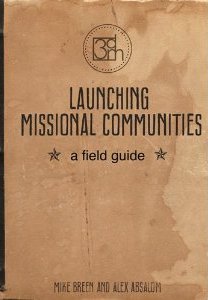
After years of demand, they finally produced a “field manual” in November 2010 for starting missional communities called Launching Missional Communities. I bought it and devoured it; it was worth every bit of the unusually high price ($29.95).

The Wikipedia article on “Missional Communities” (I suspect written by Breen or someone on his team) defines them as follows:

A Missional Community (also called Clusters, Mid-Sized Communities, Mission-Shaped Communities, MSCs) is a group of anything from 20 to 50 or more people who are united, through Christian community, around a common service and witness to a particular neighborhood or network of relationships. With a strong value on life together,  the group has the expressed intention of seeing those they impact choose to start following Jesus, through this more flexible and locally incarnated expression of the church. The result will often be that the group will grow and ultimately multiply into further Missional Communities. Missional Communities are most often networked within a larger church community (often with many other Missional Communities). These mid-sized communities, led by laity, are “lightweight and low maintenance” and most often meet 3-4 times a month in their missional context.

When I read this, I thought, “this is Storyline!”

The only difference is the group size of Storyline house churches – which have ranged from 5-25 – when compared with missional communities. And that difference alone has proven to be significant, for at least two reasons:

1. The fragility of smallness.

  • We had to wrap up one group this fall because about 10 of the 15 the participants moved away. Groups have life cycles, certainly. But this group’s substantial mission to a specific apartment community abruptly ceased. I didn’t sense that God was done with it, but after the transition the group lacked the social momentum to sustain the mission.
  • We started another group with four people that struggled for a year before beginning to grow, I suspect largely because it lacked the critical social mass to move off center.

2. The social energy required to multiply.

  • We learned from mentors in house church ministry that cell division was not the best approach to multiplication. Instead we sent small teams to start new house churches so as not to tear the fabric of community too much. Yet one of our house churches has sent teams to start new groups three times, and you can tell that it’s weary from it – both from saying goodbye to close spiritual friends, and also from the resulting vacuum of social energy left behind when a group sends its best people to start something new.

As a result, we’ve sensed God leading us to shift our approach from developing a network of small group-sized churches (5-20 people) to developing a network of mid-sized group churches (20-50+ people).

Here’s what it means practically for Storyline:

  • Over the past six months, we’ve been in the process of consolidating from four groups of 5-15 to two groups of approximately 20 people each, both of which are poised to grow as mid-sized group churches
  • Formation Groups (gender-specific groups of 2-4) will take on a much more prominent role as our small group structure
  • Groups in our network will have to be creative as they grow in order to find affordable, friendly space for groups upwards of 50 people; groups will likely meet in public spaces within neighborhoods or locations that are popular among the target network of relationships
  • Because we’ll soon no longer be meeting primarily in homes, we’ll increasingly begin to call our groups “churches” rather than “house churches”
  • Groups will develop a “missional vision” that specifically targets either a neighborhood or network of relationships
  • When a group reaches 40-50 people, it will look to send some of its leaders with a team of 10-15 people to start a new church in the Storyline network
  • The network as a whole will continue to meet together monthly for storytelling, fellowship, vision casting, and encouragement
  • We will shift from an individualized coaching structure (i.e., coach + house church leader) to a group coaching / discipleship “huddle,” akin to the kind practiced by 3DM (i.e., coach + all the church leaders; church leaders + their ministry teams)
  • We will begin to set our sights on all the different neighborhoods and networks we’re connected to in Dallas for future mid-sized group church planting; I can count at least five off the top of my head.

Please pray for us as we live into this new approach to structure and mission.

And stay tuned for the final segment of the three-part series about How Storyline is Changing. I’ll discuss how Storyline will become even more of a training ground for future church planters.

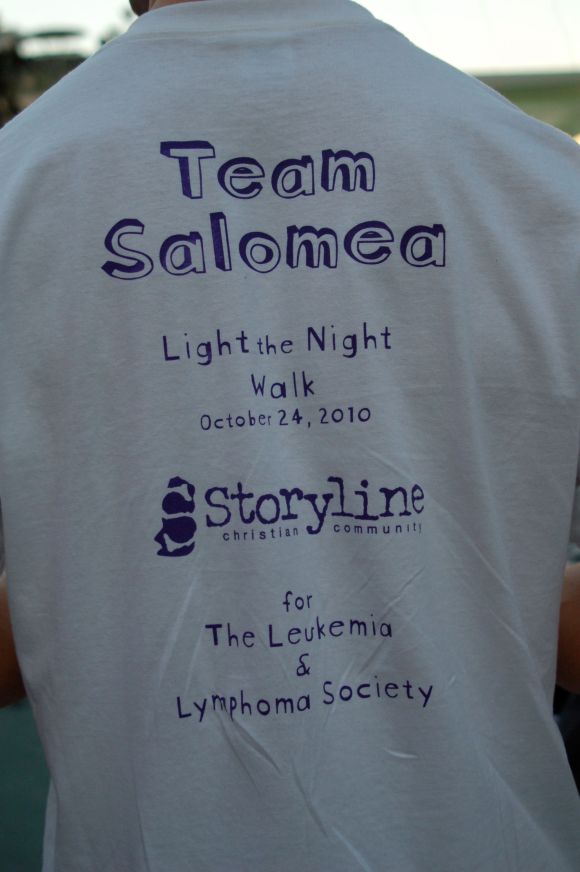
Storyline, the Paezs, and friends got together this past Sunday night for the Leukemia and Lymphoma Society’s Light the Night Walk.

We walked on behalf of the Paezs’ three year-old daughter, Salomea, who is in treatment for leukemia. Team Salomea collectively raised more than $4,400 for the Walk.

For Storyline, this was a special night in the way of Jesus, showing mercy and support – just as he would – for those who need it.

Please continue to pray with us for Salomea’s full recovery.

Thanks to everyone that gave or walked. Thanks especially to Julie Kiser and Deborah McClain for their good work in organizing the event. Thanks to Monika Paez and Clint for their work on the T-shirt design. And thanks to Elizabeth Jackson for the beautiful pictures below. Enjoy.

Starting New Churches

Charles Kiser —  October 14, 2010 — 3 Comments

One of Storyline’s values is reproducibility. We acknowledge that healthy things reproduce: healthy plants drop seeds that create new plants; healthy animals mate and give life to new animals; healthy humans reproduce and give birth to babies.

That healthy things reproduce is true all throughout God’s kingdom, particularly in the church. Healthy followers of Jesus make new followers, and healthy churches start new churches.

I think the opposite is also true: unhealthy followers don’t attract new followers, and unhealthy churches don’t start new churches.

I did not become a church planter to start one church. I became a church planter to be part of a church planting movement. One practical expression of this conviction is Storyline’s commitment to give 10% of its offerings to the Harvest Fund for future church planting through Mission Alive. As of May, Storyline had given more than $7,000 to the Harvest Fund, which has helped four new churches get up off the ground so far this year. It’s a small start, but we know what God can do with small things…like mustard seeds.

Storyline has also made a commitment to invite church planters in-training into our midst – we call them “church planters in residence.”

One of my dreams for church planting has now come true: last month, we sent the Lewis family out to start a new church. They’re partnering with Mission Alive (our resource organization) and the Riverwalk Church in Wichita, KS to start a church in in the downtown area of that city. Watch this short video to hear the Lewises’ story.

My prayer is that this is the first of many churches Storyline will help to start either by offering itself as a training ground for future church planters or by providing financial support for new projects.

Pray with us, also, for the Lewises: that their house will sell; that they’ll find good teammates; that they’ll raise the rest of their financial support; and that the church they plant will bring more life to Wichita, KS.

Why do we plant churches? Because churches – when they’re healthy – bless people and the neighborhoods in which they live. That’s really all that God has ever wanted for the world that he made – so much so that God’s call to Abraham, the father of Israel and the grandfather of the church, was to be a blessing to all the people of the earth. More churches means more blessing for the world, and that’s a good thing.

MISSIO DEI Journal

Charles Kiser —  August 17, 2010 — Leave a comment

The first issue of Missio Dei journal has arrived!

Last summer I started working with several Harding Grad friends – Greg McKinzie (missionary in Peru), Nathan Bills (ThD Student @ Duke), Jason Whaley (missionary in Australia) and Danny Reese (missionary in Angola) – to create a journal that would make a contribution to the missional conversation from the Stone-Campbell tradition.

The result: Missio Dei: A Journal of Missional Theology and Praxis.

Much of the credit for the journal’s inception should be given to editorial board chair Greg McKinzie, who first dreamed of publishing such a journal, and who has shouldered the load of setting up the organization, supervising design of the journal and website, and formatting the final product.

The journal consists of four sections: Missional Theology; Missional Praxis; Reflections (for art, blogs, film, poetry, etc.); and Book Reviews. I served as the Praxis editor for the first issue.

This first issue features articles from Gailyn Van Rheenen, Mark Love, Jared Looney, and Kyle Holton. Storyliner Patrick Cone appears in the Reflections section for his film-making work.

Missio Dei is available solely in digital format from the journal’s website, www.missiodeijournal.com. The first issue is free to download after you register and log in.

Go read it and tell us what you think! And help us spread the word!