Prayer of Humility

Charles Kiser —  May 18, 2011 — 1 Comment

O Jesus meek and humble of heart, Hear me.

From the desire of being esteemed,
From the desire of being loved,
From the desire of being extolled,
From the desire of being honored,
From the desire of being praised,
From the desire of being preferred to others,
From the desire of being consulted,
From the desire of being approved,
Deliver me, Jesus.

From the fear of being humiliated,
From the fear of being despised,
From the fear of suffering rebukes,
From the fear of being calumniated,
From the fear of being forgotten,
From the fear of being ridiculed,
From the fear of being wronged,
From the fear of being suspected,
Deliver me, Jesus.

That others may be loved more than I,
That others may be esteemed more than I,
That in the opinion of the world, others may increase, and I may decrease,
That others may be chosen and I set aside,
That others may be praised and I unnoticed,
That others may be preferred to me in everything,
That others may become holier than I, provided that I become as holy as I should,
Jesus, grant me the grace to desire it. Amen.

Written by Cardinal Merry del Val.

I’ve been wrestling with this question for quite some time.

My background: I started “preaching” when I was in grade school. I competed in speech as a kid for Leadership Training for Christ. I spoke on Sunday nights occasionally for my dad, who was a preaching minister in the churches I grew up in for 20+ years. Old ladies told me I should grow up to be a preacher. I went to college and got training to be a preacher. During graduate school I was privileged to apprentice in preaching with two extremely gifted preachers.

In short, I was groomed to preach.

Yet I’ve dealt with increasing dissonance about preaching in the three years I’ve been involved in church planting (preaching, at least, as it has been framed up and defined in my lifetime) for at least 4 reasons:

1) Many of the disconnected adults I’m living among are increasingly skeptical of listening to a single individual who presumes to speak authoritatively to them – which I lump in the category of institutional suspicion that is so prevalent among emerging generations/culture. They are much more keen on communal dialogue and discernment.

2) If I’m honest, preaching in my experience does not equip people to follow Jesus at the deepest levels – in other words, it is not transformative in the way life-on-life discipleship and coaching are. Preaching functions on the level of information/cognition, no matter how funny, emotive or storied the sermon is. Discipleship, however, requires not just information but also imitation – a severe limitation of monological preaching. What bothers me is that in many churches it seems that preaching is relied on as the primary mechanism of disciple-making – yet it is inherently limited.

3) The approach to preaching in the scriptures seems significantly different than the way we practice it now. For instance, preaching in the early church seems much more dialogical than today’s monological preaching. Someone was able to ask a question of Peter in his great Pentecost sermon in Acts 2. Jesus’ best teaching moments were either in response to a question someone else asked, or a question he asked someone else.

4) The contemporary practice of preaching has contributed to an unhealthy consumer orientation and celebrity culture in American Christianity. When people don’t come to a Sunday service because their favorite preacher isn’t speaking that day, there’s a problem. And so the favorite preacher doesn’t take a break very often, which is also a problem on a few levels: a) the celebrity/icon status that preachers receive can erode their souls; b) no other preachers are able to be trained up within the congregation because inevitably few are as good initially as the celebrity preacher; c) all this panders to the idea of church as “vendor of religious goods and services” that subverts the influence of the gospel in North America.

Hugh Halter, in his book AND, makes some challenging comments about preaching that really resonate with me:

This may sound a bit crass, but here’s the real deal: most churches spend the majority of their staff time and financial resources paying for and preparing to deliver a sixty-minute program, which prioritizes preaching. All of this, even though within twenty minutes, most adults have forgotten 95 percent of what they just heard. If the church were like a business, that would be like putting 90 percent of your investment portfolio into a product that has not produced growth for the last forty years. It’s like the Houston Rockets giving Yao Ming 90 percent of the team’s salary budget and running 90 percent of the plays through him, making him responsible for shooting 90 percent of the shots and still expecting the team to win. Or it’s like trying to get your car to drive nicely when you only have one of the four wheels with an actual tire on it.

I think you get the point. We need to make intentional investment choices, and yes, you still need a 7 ft. 6 in. Chinese center on your basketball team, and you’ll certainly need that one good tire on your car. These are all important, but you’ll need a lot more than just those things. None of them can carry the load by themselves. The church service with a sermon has and always will be necessary and helpful, but if used as the main way of making missional disciples, it falls far short.

Let me be clear to say that I think preaching is important. Young adults need to hear the scriptures preached and learn to hear the voice of God through it. Preaching does equip people with important information they need to follow Jesus. And even if our approach is a bit different than early church preaching, that’s not to say that God has not used preachers powerfully – because God has.

My question is not whether or not preaching is important, but whether or not we have put too much emphasis on preaching; caused it to bear a weight it was never intended to bear; put all our discipleship eggs in the preaching basket when it was only made to hold a couple of them.

The four reasons above are part of what has caused me to revision my preaching/teaching life in the Storyline Community. For instance:

  • We have a large gathering with preaching a lot less often (monthly) than we do smaller, more conversational gatherings (weekly).
  • Others in the community have been equipped to share teaching, facilitating and preaching roles in our gatherings besides myself.
  • The preaching style has shifted from monological to dialogical. I’m learning how to ask questions and have a (literal, not just figurative) conversation with listeners in the midst of my preaching instead of plowing right through and hoping something sticks.
  • I’m learning to spend more of my time as a coach (or disciple maker) in life-on-life relationships and contexts instead of spending way too much time in sermon/teaching preparation.

Dialogue with me about this! How do these thoughts resonate with or rub against you? What reactions do you have?

Part one addressed how Storyline is changing in its approach to discipleship. Part two addressed how Storyline is changing structurally. This final post in this series addresses how Storyline is changing in regard to starting new churches and training church planters.

My calling into church planting is not to plant a single church. It’s to participate in a church planting movement.

That’s what attracted me to the leaders of Mission Alive, our church planting resource organization, whose dream is to facilitate church planting movements all over North America.

And that’s why reproduction has been programmed into the DNA of the Storyline Community. Reproduction is one way we practice mission: reproducing followers of Jesus; reproducing churches in our network; and reproducing communities that will live a similar missional existence in a different locale.

In the fall of 2010, Storyline got its first taste of starting new churches when we sent Micah and Amy Lewis to Wichita, Kansas, to start a new church in downtown Wichita. They were sent after an 18-month period of training with Storyline and are partnering with the RiverWalk Church in Wichita. Storyline continues to support them financially through the Mission Alive Harvest Fund and through monthly contributions. I also serve as a church planting coach for Micah.

One thing I learned through this experience: a church doesn’t have to have all of its ducks in a row to be a church planting church.

  • A church planting church doesn’t have to be an established, mature congregation. (Storyline is not.)
  • A church planting church doesn’t have to have a sizable annual budget with significant financial resources. (Storyline does not.)
  • A church planting church doesn’t have to have all the training and equipping resources within itself. (Storyline does not.)

That’s the great thing about the kingdom: the power of partnership — the power of collaboration (another one of Storyline’s values).

In the kingdom, young churches like Storyline can partner together with established churches like RiverWalk in Wichita — which have significant financial resources among other things. Young churches can partner with resource organizations like Mission Alive — which has well-developed mechanisms for assessment, equipping and coaching for church planting.

Relatively new churches like Storyline bring something to the table, too: the experience of church planting. The feeling of the missional frontier. A test laboratory experience that has elements of risk but is safer and more stable than church planting from scratch. Pre-existing structures and methods for mission that stir the imagination and prepare future church planters for their calling.

Who says a single church has to do church planting on its own? Young churches, established churches, and resource organizations need each other. They need to work together for the sake of church planting. Each will likely miss something if they attempt to go at it on their own.

Storyline, as a young church, wants to play its role well in this kingdom endeavor. We want to play to our strengths.

As a result, Storyline will become a more significant training ground for future church planters. We want to see the story of Micah and Amy Lewis multiplied many times over.

We’re dreaming about helping to start five new churches in the next five years.

We’re issuing an open invitation to anyone sensing the call into missional church planting to have a conversation with us about training with Storyline.

Church Planting Residency Overview:

  • Move to Dallas and spend 2-3 years with the Storyline Community
  • Work bi-vocationally as a way of supporting your ministry and embedding in Dallas community
  • Learn how to raise funds from churches and individuals to help support your training period and future church planting.
  • Most church planters have to raise funds, after all, so why not get some practice with people who’ve had experience doing it themselves?
  • Receive a small stipend of financial support from the Storyline Community
  • Partner with a resource organization like Mission Alive who can provide assessment, equipping and ongoing support for your future church planting work
  • Experience life in the Storyline Community as a participant for a season (probably somewhere in the neighborhood of six months)
  • Learn to follow Jesus by living out Storyline’s missional lifestyle
  • Be sent out to start a new church within the Storyline Community network through pursuing a specific missional vision for a particular neighborhood (geographically-based vision) or social network (relationally-based vision). What better way to learn how to start a church than to start a church before you start a church? Interested in ministry to the poor? The gay community? Chronically homeless? Refugees? Young families? Multiethnic? At-risk youth? Young single professionals? Dallas has opportunities for all these types of ministry and more, and Storyline will work with you whatever your passion.
  • Participate in the Storyline leadership team and coaching groups for personal discipleship and leadership development
  • Be trained as a ministry coach through Mission Alive and receive CoachNet certification
  • Read and process significant books about the theology and practice of church planting
  • Discern, prepare, and plan for your steps into future church planting.

Church Planter in Residence Profile:

  • Personality: people person; visionary; self-starter; entrepreneurial
  • Calling: senses God’s call into church planting
  • Family: not required; but if you have one, must have full support of spouse for church planting ministry
  • Aptitude: willing to be assessed by church planting organization like Mission Alive as part of the interview process with Storyline
  • Ministry experience: must have at least 2-3 years experience serving and leading in churches either in volunteer or staff role; full-time ministry experience not required
  • Skills/gifts: group facilitation; listening; gathering; speaking; teaching; equipping; shepherding; faith; missional living; apostolic (starter); leadership
  • Education: most cases at least a Bachelor’s degree, though not necessarily in theological studies; ideally holds, pursuing, or willing to pursue a Master’s degree in theological education (e.g., Master of Christian Ministry or Master of Divinity)
  • Theological orientation: must be a follower of Jesus; must have a commitment to historic Christianity as expressed in the Apostles’ Creed and Storyline’s telling of the story of God
  • Denominational background: no particular background required

I’d love to bring in 2-3 families this fall to begin our work together. And I suspect that God may raise up longer term co-workers with Storyline out of those who come to train for church planting. All of that will have to be discerned along the way.

Are you interested, or know someone who might be? Contact us!

You can email me and let me know. At that point we’ll begin the interview process to discern if there’s a good fit for training with the Storyline Community.

Please pray for Storyline as we seek to continue to be used by God in the emerging church planting movement in North America.

The first post in this series addressed how Storyline does discipleship. This post addresses how Storyline is structured.

I’ve always struggled to find literature and resources for methodology and structure that spoke to Storyline’s context. As a network of house churches that meets all together for a monthly gathering and every remaining weekend for house church gatherings, we fall in between the poles of ministry structure from which most material on church methodology is produced.

On one end, you have the traditional church growth, Sunday service-oriented, high impact, programmatic, megachurch literature. Think Andy Stanley; Rick Warren; Nelson Searcy. There’s some good stuff there, but it doesn’t fit a community that does not have as its primary strategy to grow by increasing the attendance of its weekend services.

On the other end is the simple, organic, house church, non-institutional, micro-church literature. Think Neil Cole; Wolfgang Simpson; Frank Viola. There’s some very good stuff here, too, but most of this literature is geared for individual organic communities that don’t ever exceed more than 20-30 people in size. Storyline, however, is structured as a network of house churches. A network has more organizational structure and different size dynamics than a single house church. So while Storyline shares most of the values of the missional paradigm found often in more organic-type churches, it is more structured than most.

As you can imagine, it’s been difficult finding mentors and resources to speak directly at what we’re experimenting with in the Storyline Community. For a long time, the most helpful by far were Hugh Halter and Matt Smay – particularly their book AND. The community they started in Denver, CO – Adullam – has a large gathering every Sunday, but is held together by a network of “incarnational communities” or “villages” that lives on mission in various neighborhoods. Still, the weekly frequency of Adullam’s large gatherings has different implications for them than for Storyline.

And then…

I discovered 3DM and “Missional Communities.

The mental grenade was first thrown by Alan Hirsch at a small training event I attended for church planters in October 2010. He said, “The small group, nuclear family, 6-12 people approach to church is not sustainable. The structure of the early church centered on the form of oikos, an extended family household, usually between 20-50 people.”

As a house church planter, I knew he was right. Before that point, I had not been ready to admit it. The recent transitions and plateau in Storyline had prepared me to own up to it.

I later discovered that Hirsch was drawing on the very important work of Mike Breen (and company) around “Missional Communities.” In the past 20 years, they had facilitated the start of hundreds of missional communities all over Europe. In fact, the European Church Planting Network (associated with Leadership Network), adopted the MC approach and started more than 720 churches in three years (2006-2009). That’s a first in European church history.

Mike Breen has since moved to South Carolina and is training American pastors and church planters in this approach through the resource organization 3DM.

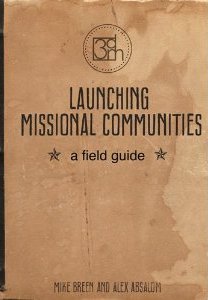
After years of demand, they finally produced a “field manual” in November 2010 for starting missional communities called Launching Missional Communities. I bought it and devoured it; it was worth every bit of the unusually high price ($29.95).

The Wikipedia article on “Missional Communities” (I suspect written by Breen or someone on his team) defines them as follows:

A Missional Community (also called Clusters, Mid-Sized Communities, Mission-Shaped Communities, MSCs) is a group of anything from 20 to 50 or more people who are united, through Christian community, around a common service and witness to a particular neighborhood or network of relationships. With a strong value on life together,  the group has the expressed intention of seeing those they impact choose to start following Jesus, through this more flexible and locally incarnated expression of the church. The result will often be that the group will grow and ultimately multiply into further Missional Communities. Missional Communities are most often networked within a larger church community (often with many other Missional Communities). These mid-sized communities, led by laity, are “lightweight and low maintenance” and most often meet 3-4 times a month in their missional context.

When I read this, I thought, “this is Storyline!”

The only difference is the group size of Storyline house churches – which have ranged from 5-25 – when compared with missional communities. And that difference alone has proven to be significant, for at least two reasons:

1. The fragility of smallness.

  • We had to wrap up one group this fall because about 10 of the 15 the participants moved away. Groups have life cycles, certainly. But this group’s substantial mission to a specific apartment community abruptly ceased. I didn’t sense that God was done with it, but after the transition the group lacked the social momentum to sustain the mission.
  • We started another group with four people that struggled for a year before beginning to grow, I suspect largely because it lacked the critical social mass to move off center.

2. The social energy required to multiply.

  • We learned from mentors in house church ministry that cell division was not the best approach to multiplication. Instead we sent small teams to start new house churches so as not to tear the fabric of community too much. Yet one of our house churches has sent teams to start new groups three times, and you can tell that it’s weary from it – both from saying goodbye to close spiritual friends, and also from the resulting vacuum of social energy left behind when a group sends its best people to start something new.

As a result, we’ve sensed God leading us to shift our approach from developing a network of small group-sized churches (5-20 people) to developing a network of mid-sized group churches (20-50+ people).

Here’s what it means practically for Storyline:

  • Over the past six months, we’ve been in the process of consolidating from four groups of 5-15 to two groups of approximately 20 people each, both of which are poised to grow as mid-sized group churches
  • Formation Groups (gender-specific groups of 2-4) will take on a much more prominent role as our small group structure
  • Groups in our network will have to be creative as they grow in order to find affordable, friendly space for groups upwards of 50 people; groups will likely meet in public spaces within neighborhoods or locations that are popular among the target network of relationships
  • Because we’ll soon no longer be meeting primarily in homes, we’ll increasingly begin to call our groups “churches” rather than “house churches”
  • Groups will develop a “missional vision” that specifically targets either a neighborhood or network of relationships
  • When a group reaches 40-50 people, it will look to send some of its leaders with a team of 10-15 people to start a new church in the Storyline network
  • The network as a whole will continue to meet together monthly for storytelling, fellowship, vision casting, and encouragement
  • We will shift from an individualized coaching structure (i.e., coach + house church leader) to a group coaching / discipleship “huddle,” akin to the kind practiced by 3DM (i.e., coach + all the church leaders; church leaders + their ministry teams)
  • We will begin to set our sights on all the different neighborhoods and networks we’re connected to in Dallas for future mid-sized group church planting; I can count at least five off the top of my head.

Please pray for us as we live into this new approach to structure and mission.

And stay tuned for the final segment of the three-part series about How Storyline is Changing. I’ll discuss how Storyline will become even more of a training ground for future church planters.

When Storyline began, we committed ourselves to live out a value for adaptability in mission, knowing that times would come when we need to adapt and flex because of changing circumstances.

I’m so thankful that this value has not remained at the aspirational level. We have indeed practiced it. For instance:

  • We thought we were going to be a “Sunday morning” church. But we adapted and morphed into a network of house churches.
  • We thought we were going to be a church for young adult professionals. But we adapted as we spent time among friends in poverty and welcomed them into our spiritual family alongside young adults.

I feel strongly that these adaptations were in sync with promptings from God’s Spirit.

And now, Storyline finds itself in a season of adaptation again this spring.

The Backstory

Last fall, several things happened that helped us to see that Storyline was “missing” something:

  1. Approximately 30% of our small community transitioned awaynone because of any conflict or bad feeling toward Storyline (praise the Lord). Mainly because of life transitions – new jobs, new cities, moving to be closer to family, etc.
  2. Storyline had plateaued in its growth and development in the nine months preceding the transitions. No new groups had started. About the same number of people were participating as were at the beginning of 2010. (This was a new trend for us – Storyline had doubled or tripled in size each of the preceding two years.)
  3. Participation in our Formation Retreats had dwindled significantly. We cancelled two Marvelous Light retreats in 2010.
  4. The equipping staff – Ryan Porche and I – had taken second jobs to help sustain our ministry financially which resulted in us working less with Storyline.

What did we make of it? What was missing?

After spending much time in prayer and discernment with the leadership team, we sensed that at the heart of our plateau was a struggle to do discipleship at a deeper level. Storyliners, both those with Christian backgrounds and those without, were not being adequately equipped to follow Jesus in a way that led them out in consistent mission.


It’s not hard to grow a church. It’s just really hard to make disciples. — Mick Woodhead

One reason for the discipleship deficit, we perceived, was because we had developed no way to allow participants within Storyline to make a commitment to following Jesus with Storyline. In an attempt to be non-institutional amidst a context where people are very suspicious of the institution, we had shrunk back from asking for people to commit to the life of Storyline in any formal way.

I’ve come to the conclusion that a ‘bar’ cannot be set in following Jesus unless there exists such an underlying covenant to journey together. Discipleship is too hard to hope that people will just get it on their own. We were made to follow Jesus in community – together – and that assumes some kind of commitment to each other.

I’ve had a hard time admitting this, particularly because I have absolutely hated the frequently unjust and inhospitable practice of “church membership” up to this point in my life. And that might not be saying it strongly enough.

Further, the communal nature of discipleship means that programs and events – like our worship gatherings, retreats, and even house church gatherings – cannot accomplish our goals for discipleship in and of themselves. Learning to follow Jesus is something that takes place in the context of day-to-day relationships, where the lifestyle of Jesus is rubbed off from more radical followers (leaders) to others.

Acts 2:42-47 seems to represent a kind of covenant that followers of Jesus in the early church made with each other: they “devoted themselves” to the apostles’ teaching, prayer, giving, sharing, doing life together, and worshiping.

How are we responding? How are we adapting?

My friend and fellow Mission Alive church planter Kester Smith with the Immanuel Community in Austin, Texas, painted a winsome picture of communal discipleship for me in a class at the ACU Summit in September 2010.

He spoke about how the Immanuel Community, out of struggles similar to Storyline’s, had developed a “Way of Life” – a rule or order – that the members of the community had committed to live out together. The Way of Life included things like daily prayer, weekly worship with the community, hospitality toward new people, service and confession. Sounds like Acts 2:42-47. (You can read the whole thing here.)

The Immanuel Community reflects a growing movement in missional communities toward a “communal rule” as the primary way of doing discipleship.

Alan Hirsch, in The Forgotten Ways, describes it as a shift of focus from core beliefs to core practices — a shift from asking what do followers of Jesus believe to how do followers of Jesus live?

Beliefs are certainly important. They just mean very little unless they are put to action. James says that passive belief is dead (James 2:17). “Even the demons believe.”


It is less important to ask a Christian what he believes about the Bible than it is to inquire what he does with it. — Leslie Newbigin

This “rule of life” approach to discipleship has become so helpful that Mission Alive, my resourcing organization, has made the development of a communal rule of life the focus of its week long Strategy Lab for church planters and church leaders.

As a result, the Storyline Leadership Team has prayed through and developed what we’re calling the “Storyline Lifestyle.” It is our first attempt at a communal rule of life in the way of Jesus. It is the way, in our particular locale, we live out the STORY of God:

  • Sharing life with disconnected or downtrodden friends at least weekly
  • Taking ownership of our spiritual formation in formation groups weekly
  • Opening ourselves to God through prayer and Scripture daily
  • Rallying together with our spiritual family at least weekly
  • Yielding our resources generously to the mission at least monthly

To equip our community to begin to live this lifestyle, we’ve created a 6-week bootcamp that’s called Lifestyle DNA. It’s a catechesis of sorts – spiritual training for newcomers to Storyline. We spend one week framing up the gospel and the lifestyle of Jesus as a response of gratitude to the grace God gives us in Jesus; then the remaining five weeks practicing each of the five life rhythms in community.

At the end of Lifestyle DNA, previously Christian participants can choose to partner with Storyline in its mission and are commissioned publicly in our community gatherings. Not-yet-Christians are given the opportunity to make the decision to follow Jesus and demonstrate their commitment to God and the community publicly in baptism.

After completing Lifestyle DNA, two things keep the lifestyle in front of Storyliners: 1) Formation Groups – gender specific groups of 2-4 people who gather for confession and prayer – are being retooled to flow out of the Storyline Lifestyle; 2) House church leaders will also help by sharing life with and coaching those who have decided to partner with Storyline in mission.

Our leaders have just finished a pilot run of Lifestyle DNA together, and already I can see how my life is changing. Parts of my brokenness are healing up; my connection to God has deepened; and I have a much keener sense of God’s presence when I’m on mission.

Pray for our community as we start the first community-wide Lifestyle DNA tomorrow night!

Stay tuned for upcoming conversations about how Storyline is changing. Part two addresses how Storyline will change structurally. Part three addresses how Storyline will become even more of a training ground for future church planters.