What about Teaching?

Charles Kiser —  March 25, 2009 — 18 Comments

askWe talk often about translating more established, institutional ways of being church into more grassroots, decentralized expressions.

One topic that I’ve been struggling to translate is the role of preaching/teaching in the grassroots paradigm.

I’m wrestling with two points of tension.

On one hand, I have some level of dissatisfaction with the way church participants in more established contexts are overly dependent upon a teacher for their Bible study.

In many institutional contexts, the Senior Pastor/Preaching Minister is the fountainhead of biblical knowledge and truth and parishioners attend services to hear his (or her) words of wisdom. Many church members leave worship services believing they have had their dose of the Bible for the week.

The Barna Group has conducted some incisive research that demonstrates the growing levels of biblical illiteracy among American Christians. I wonder if this is partly because of an unhealthy dependence on teacher figures in the church.

Organic church leaders like Cole rail against teacher overdependence in favor of a more egalitarian, everyone-can-hear-from-God-through-Scripture approach. They also downplay the role of seminary experiences and highly cognitive theological education.

Yet, on the other hand, I’ve been part of less than stellar small group experiences that weren’t much more than sessions for pooling ignorance (not with Storyline, of course – all of our house church gatherings are awesome!). Even when Scripture was the center of discussion the group was somehow able to override the message of the text in favor of its preexisting assumptions.

There are other times when there is so much distance between the culture of a Scriptural text and contemporary culture that a group of people reading the Scripture can badly appropriate it because the text’s import is lost on them. For example, I know women who cover their heads in worship gatherings because they think it is required of them from texts like 1 Corinthians 11.

Moreover, I do think there is a place for a teaching gift in the church. Paul, after all, mentioned teachers among the big five equipping gifts in Ephesians 4. He also encourages teaching responsibilities for some of his apprentices like Timothy.

Up to this point, this is the role teaching has played in the Storyline Community: 1) I teach once a month in our community worship gatherings; 2) I share a teaching role in our formation retreats (like Marvelous Light and City on a Hill).

I also write the curriculum that frames up conversations for our house church gatherings. But these are not teaching opportunities. There are no podiums. There are no dry erase boards. The Holy Spirit teaches house churches as they listen to Scripture together.

Perhaps a fundamental issue in this conversation is how one defines teaching. In many established churches, teaching is provision of information about the Bible. In many organic approaches, teaching is less about information more about obedience and life change.

I much prefer the latter definition. It’s the reason my teaching and our house church conversations move from observation of Scripture (what’s going on), to interpretation of Scripture (what it means), to application (how it changes us).

To restate the tension, many traditional paradigms of teaching get stuck on observation and interpretation and almost completely neglect application. Such observation and interpretation often comes from a highly trained, highly paid leader. At the same time, I fear that some organic approaches move so quickly/poorly through observation and interpretation that application is shallow or just misguided.

I don’t want Storyline’s spiritual health to be overly dependent on me as a teacher. I also don’t want Storyline’s spiritual health to be shallow or misguided because it doesn’t have good frameworks for understanding Scripture.

How do you / would you navigate this tension?

Julie and I have not been satisfied with the size of Storyline’s Children’s Ministry…

So we decided to expand it ourselves!

That’s right, Julie’s pregnant again and we’re expecting the new baby around October 3rd.

We broke the news to our families by taking them one of our favorite desserts, Sprinkles cupcakes. Julie placed a special order and had baby ‘toppers’ put on them. It took the family a second to figure it out. Watching the looks on our parents’ faces as the shock of the news hit them was hilarious.

We should have more babies so that I can enjoy the fun of surprising people — though Julie would probably take issue eventually.

Julie and Charles

sprinkles

Woo hoo! Our lives just keep changing!

New Life

Charles Kiser —  February 24, 2009 — 17 Comments

lowell1

This week has been full of new life on a couple fronts.

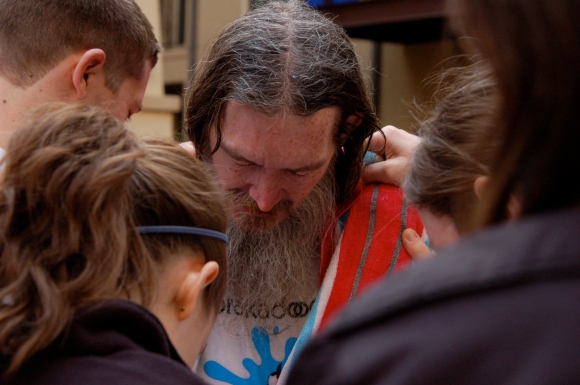
Front #1: on Sunday afternoon, Storyline house churches gathered for the baptism ceremony of Lowell Rhodes. We met Lowell at our first neighbor’s lunch last fall and he has been part of Storyline ever since.

While we stood around the pool, Lowell shared with us that he had been baptized at a very early age but didn’t understand its significance. He wanted now to be baptized because Jesus was baptized — and Jesus is the one who he wants to follow in every way.

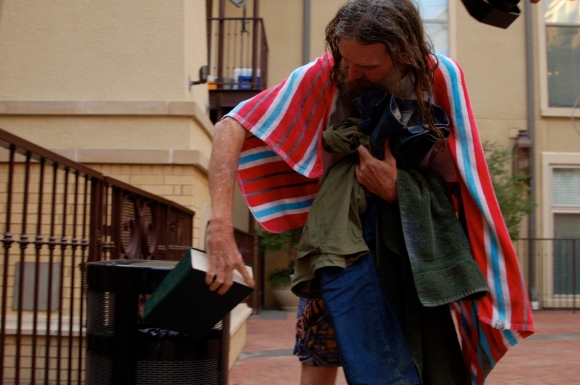
Lowell also brought an internationally recognized, one-volume encyclopedia of chemicals, drugs, and biologicals: the Merck Index.

He explained that he bought it many years ago because he wanted to learn how to make drugs that he could sell to other people at high prices and become rich. In fact, in his old life Lowell was a drug dealer for quite some time.

Lowell declared in a public way that he had left that life behind forever.

lowell21

lowell-3

After Lowell was baptized, he threw the Merck Index in the trash as a symbol of the old life he was leaving behind and the new life of which he was taking hold.

lowell-4

lowell-5

Rejoice with us for Lowell’s act of faith!

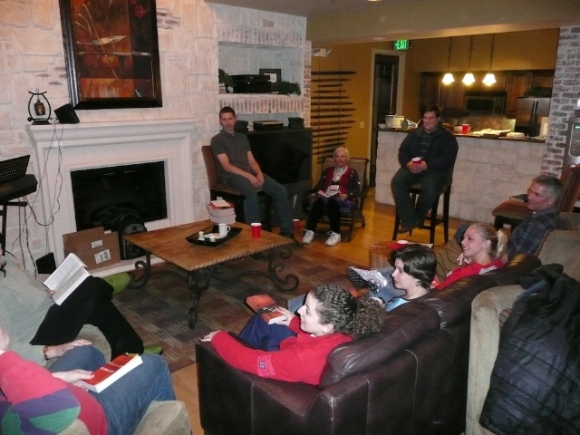
Front #2: Last night, ten of us gathered at 1001 Ross in Downtown for the first meeting off the 1001 Ross House Church. More people participated in house church gatherings last weekend than any other weekend since Storyline started.

1001-ross-pic

God is sending us a new wave of growth that we are attempting to ride with faith and obedience. It’s an exciting, stretching time for us.

Please pray that God will continue to nurture the new life that is sprouting up in the Storyline Community.

Journey into Justice

Charles Kiser —  February 18, 2009 — 8 Comments

We want Storyline to be a community that works for justice.

Part of the reason we decided for a context in the city was because of its proximity to poverty and injustice. We wanted to be close enough to serve and love oppressed people, and even stand up for what was right before the powers that be.

We know that much. That much, in fact, has come to us pretty easily.

Discovering how to go about being that kind of community has been a much more difficult process.

I read somewhere recently about a distinction Brian McLaren made between justice and mercy. He said that mercy is caring for people who were made sick, for instance, when they drank polluted water from a nearby stream.

Working for justice, on the other hand, is going upstream to see who polluted the water and getting them to stop.

I love the analogy of the river. We’d do well to translate it into other contemporary metaphors of injustice.

McLaren’s definition of justice, however, seems to put forward a false distinction between justice and mercy. Justice in the Hebrew prophets seems to be both confrontational and merciful. Working for justice to “roll down like a river,” in Amos’ words, was both to uproot unjust rulers and to care for those in poverty.

To work for justice is both to care for people made sick by polluted water and also to stop the people who are polluting the water.

Here’s a million dollar question I’m wrestling with: what does it look like for Storyline to work for both facets of justice in a way that’s consistent with our values and style?

Last year I attended the National New Church Conference (aka Exponential) and listened to David Mills talk about conducting a “community needs assessment.”

The needs assessment entails networking with and interviewing social service organizations in the community for the sake of discerning deeper needs. Mills even suggested forming a separate nonprofit organization that would one day fill a niche in the community discovered by the needs assessment process.

I loved the idea and began to pursue it. But as I talked with my friends in Dallas who work in social services and community development, the idea didn’t gain much traction.

It began not to sit well with me either, but I could not put my finger on why.

Then it dawned on me: a needs assessment process and the development of a separate nonprofit for justice is an institutional way of working for justice.

It starts at the top — discerning needs from those who work with people in poverty, rather than discerning needs by serving and living among people at the bottom in a grassroots, relational way.

What would it look like to translate yet another institutional paradigm for ministry into a more organic one?

Perhaps we start by asking our Storyline people who live among the poor what needs they see in the lives of their neighbors. Then we seek to enter into relationship with them and serve them.

Perhaps we adopt their neighborhoods and even one day move into them.

Perhaps our justice ministry is not centralized but rather localized within our house churches such that each works for justice in ways that connect to its particular passions, gifts, neighbors and neighborhoods.

We’ll network with social service organizations not to discern needs but rather to ask for help with the needs we’re discovering because we’re involved relationally in the lives of hurting people.

These kinds of things are already happening within each house church in the Storyline Community, despite my sluggishness. The jobless are getting help with networking and resume development. Those on the cusp of being evicted are getting rent assistance from grassroots collections in the community. Those who need groceries for the week are getting them.

It seems I am, as always, one step behind what God is already doing.

When the time comes, as we’re in the thick of loving and serving people in such ways, house churches will begin to sniff out the larger, systemic forces that oppress our neighbors.

So we’ll collaborate with our friends in social services and community development and begin to bark and lay our lives on the line until things change on a systemic level.

God, of course, will be the one with the power to change systems of such scope.

What do you think of all this crazy talk? Help me translate. What would it look like for churches to work for justice in more organic ways?