Archives For November 30, 1999

New Partners in Mission

Charles Kiser —  January 10, 2012 — 2 Comments

Storyline commissioned three Partners in Mission this weekend at our Community Gathering.

Partners in Mission are those who want to make Storyline “their church” by aligning themselves with Storyline’s values (dependence on God; mission; life change; genuine relationships) and practices (mission; confession; devotion; community; generosity).

Partners in Mission prepare for partnership through Storyline DNA (orientation to Storyline) and Lifestyle DNA (a six-week course to equip partners in Storyline’s lifestyle.

What a great way to start the new year!

What does partnership with your community of faith look like?

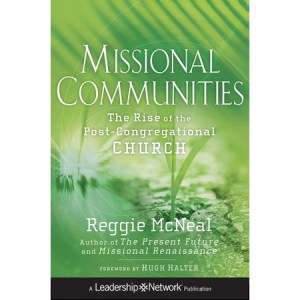
Reggie McNeal has a new book out that I’d like to recommend called Missional Communities: The Rise of the Post-Congregational Church.

McNeal’s purpose in this book is to describe from high altitude the growing phenomenon in North America he calls “missional communities,” an alternative expression of church in our time.

The phrase “missional communities” suggests the distinctive characteristic of these groups: mission is the organizing principle. They are embedded in a particular neighborhood or network of relationships. They focus on discipleship, hospitality and justice work. They develop a close-knit sense of community around the mission. They are led most often by non-paid leaders. They aim to help searchers find their way into the Christian community.

McNeal submits that these ecclesial expressions are a legitimate form of church and should be embraced as such. They are very different from their congregational counterparts, and yet not necessarily a replacement for them.

After introducing key concepts in the first two chapters, he surveys five recent movements that give evidence to the rise of the “post-congregational church”:

  1. 3 Dimensional Ministries
  2. Soma Communities
  3. Campus Renewal UT
  4. Future Travelers
  5. Mission Houston

Here’s the value I see in McNeal’s book:

  • McNeal writes as a Baby Boomer – someone my parents’ age, many of whom have grown up and lead in congregational forms of church.
  • The book offers a helpful framework: I like the functional comparison of “congregational” form of church and “post-congregational” or “missional community.” It brings clarity to what’s happening in the North American church.
  • The approach is very gracious. The purpose is not to lambast the congregational expression but rather to uphold the missional community as a viable alternative. In fact, many networks of missional communities are nurtured out of the congregational form of church.
  • The stories. I have one friend who has said to me repeatedly: I really think the germinal/organic/missional church approach is the wave of the future, I just want to see it work! Read this book, friend, and see 5 movements that are thriving examples of the missional community approach.
  • It affirms God’s work in Storyline. To be honest, I feel like a church outsider most of the time and downright crazy just a little less of the time because of my work as a missional communities practitioner. What excites me about the five movements studied from all over North America is that it’s very clear that this is not an isolated incident. It is the movement of the Holy Spirit. The examples listed here are just the tip of the iceberg when it comes to this growing expression of church.

Pick up the book! Share it with others who would benefit from seeing what God is up to in the North American church.

What are we going to do about Christmas?

For the first time, I feel like I’m entering into the debate in a serious way – my own life and family rhythms are on the line. What am I going to do about it? Up to this point, I’ve gone into default mode – I do what my family has always done. Wanting to be more responsible and adult, I’m trying to reflect intentionally on it this year.


The debate has gone something like: should Christmas be observed as a religious holiday or as a cultural holiday?

In other words, is Christmas about Jesus, or is it about a time of celebration and gift-giving with friends and family?

Practically, people respond to the question by observing the Christmas season in a handful of ways:

  1. Observe it as a religious holiday but not as a cultural holiday. Jesus should be stripped away from the commercialization and materialism of the holiday season. Jesus is the (only) reason for the season. E.g., the message of the little movie Charlie Brown’s Christmas. Also anyone who uses the language of “taking back Christmas for Jesus.”
  2. Observe it as a cultural holiday but not as a religious holiday. I grew up with this perspective in Churches of Christ. The line of thinking: a) Jesus wasn’t born on December 25 (which is true); b) Christians don’t worship the baby Jesus; c) Christians remember the life, death and resurrection of Jesus every week in their gatherings; d) So Christians don’t celebrate Christmas the way the rest of the “world” (used often very negatively) does. We did, however, celebrate Santa and presents etc. with the rest of the “world”. I suspect most atheists prefer to celebrate Christmas this way, too. Irony intended.
  3. Observe it as a religious/cultural holiday. This approach rolls it all up into one big holiday ball: we sing Silent Night and Jingle Bells right alongside each other; we talk about both Santa and Jesus; we buy gifts for family and we go to Christmas Eve service to celebrate the incarnation; we even try to talk about how the cultural values around Christmas (e.g., gift-giving) emerge from the story of Jesus. Yet we certainly disapprove (though sometimes succumb to) the extremes of materialism and over-consumption that occur in the broader culture during this holiday. I suspect most Christians fall in this camp.
  4. Observe it as separate religious and cultural holidays. This perspective is new to me. In fact, I just read one writer’s proposal about this approach in an article today in USA Today. She proposes that we don’t try to meld the two together or fight about how we should celebrate either the religious or cultural expression. What if it wasn’t either/or but both/and? What if we just distinguished between the two and practiced them as separate holidays that happen to overlap (and fall on the same day)?
  5. Observe it neither as a cultural or religious holiday. I have friends who eschew the whole season of Christmas as a combination of #1 and #2. The cultural practices are unacceptable expressions of materialism and commercialism. The religious practices are unacceptable because Jesus wasn’t born on Christmas. So they don’t practice either.

Personally, I’m leaning toward #4. For these reasons:

  • As a missionary, I cannot hide from cultural practices but must rather engage them as a way of helping people see God in the midst of them. In my world, there is no secular and sacred divide. All is God’s.
  • As a believer, I cannot say that the cultural expression of Christmas is altogether bad – giving gifts, helping those in need, and spending quality time with friends and family are all quite good things. I can affirm these things without affirming materialism, greed and selfishness.
  • As a believer, I also cannot deny the historic Christian faith and the Christian calendar that’s been around for 1600 years. I’m ready to get past the fact that Jesus wasn’t born on December 25 and that Christmas first emerged in conjunction with a pagan holiday (so did Easter, by the way) and use the Christian calendar (re:Advent and Christmas) as an opportunity to live into the story of Jesus with my family and church. I find tremendous solidarity with the people of God in doing so.
  • I’m concerned about what will happen if my family celebrates Christmas as a religious/cultural holiday. Will my kids ask me questions like: “So are Santa and Jesus cousins?” Or, “So is Jesus Santa’s Helper or is Santa Jesus’ helper?” How do you pull all that off without getting confused yourself?

What do you think? If you’re willing to engage the debate yet another time – share with us how you’re choosing to live out the Christmas season and why. And make sure to be nice about it (as opposed to naughty).

Happy Advent, everyone.

For those of you who didn’t grow up with the Christian calendar – I didn’t either – Advent is the four-week season starting the Sunday after Thanksgiving and culminating on Christmas day. It’s a season of anticipation and waiting for the arrival, or advent, of King Jesus into the world. It is preparation for the incarnation that is celebrated on Christmas.

As a way of teaching our kids about the season of Advent – and also to teach them that Christmas is not primarily about getting a Star Wars lightsaber or a princess doll that burps after feeding – we borrowed a great idea from our friend Summer Newman called the Jesse Tree. You should read her great post about their Jesse Tree last Advent if this interests you.

We set up a little tree on our dinner table with four purple candles around it (a symbol of Jesus’ royalty). Beside it sits a our kids’ Bible and a little box. In the box is a white candle (to be lit on Christmas day), four pieces of candy (because chocolate is delicious), a lighter, an ornament for that day, and a little card with a Bible story and prayer for the day. The daily Bible stories walk through the major moves of God’s story in Scripture that anticipate the arrival of the Messiah. You can see a PDF file of the ornaments and daily prayer cards here.

Each day after dinner during Advent, we’ll open the box together, light the candles, eat some chocolate, read a Bible story that anticipates the birth of Jesus, color and hang an ornament on the tree (each day’s ornament corresponds with the Bible story), and pray together.

I think the Jewish Community is really on to something in the way they train their children in the faith with hands-on spiritual practices. It’s fun and enriching – not just for the kids, but for the parents, too.

What does your family do to prepare for the birth of Jesus in the Advent season? Share your family traditions (so we can copy them)!

  1. an earnest desire for some type of achievement or distinction, as power, honor, fame, or wealth, and the willingness to strive for its attainment: Too much ambition caused him to be disliked by his colleagues.

I’m an ambitious person. For whatever reason, I’m driven to succeed. I want to be the best. And not for my own fame or notoriety (primarily) – if I can succeed in church planting and justice work, it will mean that lots of people will be helped and blessed. I want to do well in helping others do well.

Here’s my question for dialogue: is this mentality something to applaud or something to confess?

Many would probably applaud it – what’s not to like about seeking excellence, especially for the benefit of others?

Yet I think there’s something dangerous, insidious and subversive in this kind of ambition, particularly because it can hide behind good deeds.

Ambition for doing good has the potential to be selfishness and pride dressed in holy clothing.

I say this because I know my own heart.

Church planting – a good, people-blessing enterprise – has at times been an idol I’ve put my hope in rather than God. At times I have secretly hoped it would put me on the map, make me a big deal, build my kingdom. (Writing that for all to see helps me to realize how silly it is.)

Paul similarly described some who preached the gospel – a good thing – as doing so out of “selfish ambition” – because they wanted to get him into trouble. (Philippians 2:17).

Elsewhere, when Paul talks about being “ambitious to preach” himself with a noble motive (Romans 15:20, TNIV) – he doesn’t use the same word/idea he did in Philippians 2. Translators decided that “ambition” was the best way to render it. I’m not sure it is, given the way our culture defines the word – as the pursuit of achievement or distinction for oneself. The American brand of ambition seems to be inherently selfish.

So what do we do with ambition for good things? Can ambition be redeemed in the kingdom? 

The words of Jesus come to mind: “So do not worry, saying, ‘What shall we eat?’ or ‘What shall we drink?’ or ‘What shall we wear?’ For the pagans run after all these things, and your heavenly Father knows that you need them. But seek first his kingdom and his righteousness, and all these things will be given to you as well.” (Matthew 6:32-33)

Here’s my paraphrase of what Jesus is saying in the terms of this conversation about ambition: Make God your number one ambition. The pagans are ambitious about everything else – food, clothes, careers. But not you. If you seek after God and make it your primary ambition to know him and love him, everything else – food, clothes and careers – will fall into place.

Perhaps there is room in the kingdom for ambition to do good, but only insofar as that ambition is judged, measured and held in check by a primary ambition to know and love God.

What do you think? Please join the dialogue!