Archives For November 30, 1999

Touch A Life

Charles Kiser —  January 1, 2009 — 3 Comments

Happy New Year!

In the month of December, Storyline participated in the Advent Conspiracy, a movement of churches and people to revive and reclaim the Christmas season by worshipping fully, spending less, giving more and loving all.

touch-a-life

As a way of expressing our commitment to spend less on Christmas presents, give more of ourselves to other people and love all God’s people, particularly the downtrodden, we decided to take up an offering for an organization called Touch A Life.

ChildTouch A Life helps to liberate children from slavery, abuse and exploitation in Ghana, Cambodia and Vietnam.

It was an easy decision because in one sense Storyline already has something invested in Touch A Life.

One of our Storyline leaders, Patrick Cone, has recently made a documentary about Touch A Life’s work to free children sold to work on Lake Volta in Ghana, West Africa.

You can watch the video here. It’s worth your time.

Oprah read an article in the New York Times about child slavery on Lake Volta and sent people to help free the child featured in the article only to findoprah out that someone had beaten her to it — Pam and Randy Cope, founders of Touch A Life. Pam had read the same article and was moved to action.

You can read Oprah’s side of the story here.

Randy and Pam also have connections to Storyline’s heritage in Churches of Christ. Randy’s brother is Mike Cope, minister for Highland Church of Christ in Abilene, Texas — one of Storyline’s supporters (and the church Ryan Porche grew up in).

I’m convinced that Randy and Pam’s work is close to God’s heart for justice and mercy.

Their ministry demonstrates the way that God’s salvation concerns not just the afterlife but also the present, when good news is proclaimed to the poor, freedom proclaimed to prisoners, and the oppressed are set free (Luke 4:18).

If you’d like to participate in our collection, you can make a donation here via PayPal with your credit card or bank account. Storyline will not be able to accept donations for Touch A Life after next Thursday, January 8th.

On Sunday, January 11, we’ll have the opportunity to present Storyline’s offering to the Copes in person at our community worship gathering.

Advent Conspiracy

Charles Kiser —  December 2, 2008 — Leave a comment

Our house churches just started a new series of conversations on the first season of the Christian calendar: Advent. Advent is about waiting for God to arrive. The Advent season highlights two ways God’s people have waited throughout the ages: 1) for the first coming of the Messiah—in the incarnation; and 2) for the second coming of the Messiah—in the eschaton.

What would it look like if the anticipation required in Advent shaped our lives? What if we waited for God through the holidays instead of waiting for presents? In tough economic times, what would it look like to wait for God to arrive?

The churches behind the Advent Conspiracy think it looks like people who trust God fully, spend less, give more and love all.

What if more and more people lived into this Advent conspiracy?

Christmas might just be an enjoyable holiday again.

More to come about ways Advent will shape the Storyline Community…

Dallas Willard on Politics

Charles Kiser —  September 29, 2008 — 1 Comment

This quote was too good not to post. From Dallas Willard’s Revolution of Character, pages 14-15:

The revolution of Jesus is first and always a revolution of the human heart. His revolution does not proceed through the means of social institutions and laws—the outer forms of our existence—intending that these would then impose a good order of life upon people who come under their power. Rather, his is a revolution of character, which proceeds by changing people from the inside through ongoing personal relationship with God and one another. It is a revolution that changes people’s ideas, beliefs, feelings, and habits of choice, as well as their bodily tendencies and social relations. It penetrates the deepest layers of their soul. External, social arrangements may be useful to this end, but they are not the end, nor are they a fundamental part of the means.

On the other hand, from those divinely renovated depths of the person, social structures will naturally be transformed so that “justice roll[s] down like waters, and righteousness like an ever-flowing stream” (Amos 5:24, NRSV). Such streams cannot flow though corrupted souls. At the same time, a changed “within” will not cooperate with public streams of unrighteousness. A transformed soul will block those streams—or die trying.

The impotence of political and social systems to bring about real change is one of the reasons Jesus didn’t send his students out to start governments or even churches as we know them today. These organizations inevitably convey some elements of a human system. Instead, his disciples were to establish beachheads of his Person, word, and power in the midst of a failing and futile humanity. They were to bring the presence of the kingdom and its King into every corner of human life by fully living in the kingdom with him….Churches—thinking now of local assemblies of Christ’s followers—would naturally result from this new kind of life.

We had a Neighbor’s Lunch this weekend at Sonny Bryan’s Smokehouse in West End. I really love these experiences. About half of our group consisted of young adult/professionals; the other half consisted of poor neighbors.


I decided to walk around downtown for about a half-hour before lunch in the hopes that I might meet someone to invite to our lunch.

I just prayed as I walked that God would show me someone to serve, to befriend.

And yes, I had the nervous butterflies. I knew God would have to work in order to push me past my anxiety about cold-turkey invitations.

As I walked God brought a text to mind in Jesus’ teaching about inviting people to a party (Luke 14:12-14):

Then Jesus said to his host, “When you give a luncheon or dinner, do not invite your friends, your brothers or sisters, your relatives, or your rich neighbors; if you do, they may invite you back and so you will be repaid. But when you give a banquet, invite the poor, the crippled, the lame, the blind, and you will be blessed. Although they cannot repay you, you will be repaid at the resurrection of the righteous.”

At the very end of my walk I saw a man sitting on a bench with a Wal-Mart sack beside him. I walked by him, looked him in the eyes and said, “Hey, how’s it going?” He responded politely.

I kept walking.

Then I heard, “Excuse me sir. Do you mind if I ask you something?”

That was all I needed. Thank you, God.

He explained that he had just moved a few weeks ago from a large city in the north to find work in Dallas. He was on the streets, and he was trying to find a way to get to Wichita Falls because he knew someone who could give him work there. The bus fare cost $43. He showed me the $30 he had and asked if I could help.

I just happened to have $15 in my pocket.

I told him, “You know it’s funny that you ask because I’ve been walking around praying that God would show me someone to help.”

That resonated with him — he told me he was also a believer.

Paul ended up coming to lunch with us and eating all the ribs he could handle. After lunch, we sent him off with enough for bus fare to Wichita Falls. We hope to hear from him again when he’s back in Dallas.


I love divine appointments. It seems that God works out all the details when I merely make myself available to him.

At future lunches we’ll invite everyone to show up early and go out into the streets and alleys praying that God would lead us to new friends. In fact, why couldn’t we do that for all our events?


On Sunday night, we talked about immigration and its relationship to spirituality and politics. Go figure that three of our poor friends from our Neighbor’s lunch came—one of whom regularly protested on behalf of two imprisoned border patrol agents, another of whom was married to an undocumented immigrant! What an interesting conversation it was.

It was also amazing to see conversation between the rich and poor, the educated and less educated. I think we discovered commonalities between the two we would have never expected.

Seriously, where else in the world can the rich and poor rub shoulders like this? That’s the beauty of the church.

In the words of one of our young adult friends at the gathering, “I could feel the presence of God with us. It was beautiful.”

We discovered in scripture God’s openhandedness and mercy toward the “stranger” or immigrant, as well as the ways certain responsibility was expected of the immigrant—particularly when the immigrant was living among God’s people.

If you’re interested in a good book on the subject, I’d encourage you to pick up Christians at the Border by M. Daniel Carroll R. It’s a short read and a good introduction on how the scriptures speak to the topic of immigration.

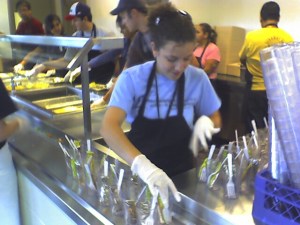
Yesterday afternoon several of us served lunch to some of our neighbors at the Bridge, a new shelter that opened up in May for the chronically homeless in downtown Dallas. Click here for a few fast facts about the facility at the Metro Dallas Homeless Alliance website, the organization that runs the Bridge. Click here for an article and video from Dallas Morning News.

We worked in conjunction with First Presbyterian Church’s ministry, The Stewpot, which serves three meals every day for the homeless at the Bridge’s cafeteria, Second Chance Café.

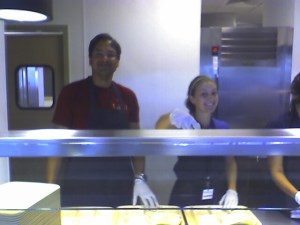
A few of us served our neighbors meals from the kitchen. Others of us filled/refilled water glasses for our neighbors at their tables.

It was a great experience — one we’ll probably begin doing regularly.

I was struck by the overwhelming number of people at the Bridge. The Café director told us the shelter was built for a capacity of 400, but sometimes hosted as many as 1,200. The facility has gotten so full that many people sleep in the courtyard area in the evenings.

Raj and Lauren, two Storyline volunteers, commented about the diversity of the people they served. Young, old, Black, White, Latino, male, female—people of all different kinds were present. Homelessness affects a wide range of people.

I’m also struck by the way the Bridge seems to corral the homeless into a corner of the downtown area (the facility is located at one of the southern most points). Other organizations, like our friends at Soup Mobile, are no longer allowed to serve food downtown. Is it a subtle (or not-so-subtle) attempt to make the homeless less visible to the wealthy professionals who work and live downtown?

I know the issues are much more complicated than I’m aware. I’m just raising questions as an outsider.

One thing is certain: the Bridge is just a beginning step of a much larger process. Given the significant overcrowding at the Bridge, it’s clear that much more help is needed to serve the poor and homeless in downtown (which makes me wonder why other organizations are being asked to leave).

I talked to a 22 year-old woman just before we left. She had been on the streets since she was sixteen. She’d gotten pregnant and then lost the child after birth. I could see desperation in her eyes. When I asked her how she was doing she shot straight with me: not good. She couldn’t find a place that gave away sanitary pads and so she was left to bleed all over herself. I could tell she was humiliated. (I know this story is uncomfortable to read — but so is the reality of the streets, to say the least.)

Yesterday afternoon I found myself thanking God for a cooled home and a comfortable bed, and praying for my neighbors like that young woman who were at that very moment sitting out in the sweltering heat.

You don’t walk away from these kinds of experiences the same person.

May justice flow through Dallas like a river.