
Archives For November 30, 1999

The Relational Principle

Charles Kiser —  November 26, 2007 — 3 Comments

Probably the most common means of evangelization in the last hundred years has been through the medium of large crowds. Billy Graham, the king of mass evangelism, has preached to nearly 100 million people in his lifetime all over the world. Many of these crowds have numbered in the thousands or hundreds of thousands. Churches of Christ were once well known for hosting gospel meetings (and some still do). Hundreds of people gather, sometimes every night for a week, to listen to preachers present the gospel.

The logic behind such gatherings is that the gospel is preached to the most people possible; the more exposure people have to the gospel message, the more likely they are to respond and follow Jesus. People who do respond in faith are then assimilated into local congregations for follow-up and discipleship. So goes the logic.

The effect of these mass evangelistic events has not been unsuccessful in terms of initial conversion. If it were, I suppose the venue wouldn’t have lasted very long. Billy Graham’s son speaks at Crusades to this day. Undoubtedly, thousands have come to faith and decided to follow Jesus because of a Crusade or gospel meeting.

Yet I wonder if the gospel is done injustice when evangelization (and discipleship, for that matter) is truncated to an oral presentation or a set of propositions in which to believe. The gospel must be preached, of course. It includes propositions to believe, for sure. But on the whole, the gospel is a way of life. The gospel is about following a person — Jesus.

At the heart of the gospel is relationship. After all, Jesus spent the majority of his time not with the crowds, but with a handful of men and women. I love the way Eugene Peterson puts it: “Jesus, it must be remembered, restricted nine tenths of his ministry to twelve Jews, because it was the only way to reach all Americans.” The gospel spreads relationally.
td.jpgThis relational principle has revolutionized our perspective on ministry in the church we’ll start. In short, the heart of the church we begin will not be a large gathering (whether an evangelistic event or a worship assembly) but rather handfuls of people who journey together in the way of Jesus.

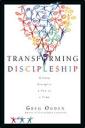
One way we envision expressing the relational principle is through gender-specific groups of three or four that meet regularly over a 6-9 month period for the sake of learning how to follow Jesus. Greg Ogden has been a great help to us in this area. He’s authored two books that have fleshed out what it looks like: Transforming Discipleship and Discipleship Essentials. The first is theological and practical rationale for such an approach. The second is a 24-lesson curriculum designed to help people learn to follow Jesus.

Three components form the foundation of these groups: Scripture, transparent relationships, and accountability. The best part is that after the groupsde.gif conclude their curriculum, each group member commits to finding two other people to journey with through it. One group becomes three, which becomes nine, which becomes twenty-seven, and so on. The gospel spreads relationally.
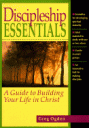
I’ve been through Discipleship Essentials once with three other guys, and am now going through it with Ryan Porche, my staff partner. Our wives plan to go through it together soon. These two groups will soon become four and function as the grassroots beginning of this new church. The curriculum isn’t perfect, but the environment is the Holy Spirit’s laboratory for life change. It’s amazing the way I’ve seen transformation take place right before my eyes. And I think it’s at the center of what it means to be the church, to be on mission, and to engage in spiritual formation.

The First Thing

Charles Kiser —  November 11, 2007 — 4 Comments

I came to the conviction in August that the last stretch of my apprenticeship (which ends in January) would have a different focus than the first part. During the first 12-14 months, I was consumed with ministry contexts and skill development. Julie and I have learned so much from Christ Journey and Sunrise, particularly in the area of creating communal pathways of spiritual formation for followers of Jesus. The Marvelous Light and City on a Hill retreats are two products of that training.

But I had a realization at the beginning of the fall: in the midst of all my labor and productivity, I had neglected my own spiritual well-being. In the process of facilitating spiritual formation in the lives of others, I had sidelined my own.

I’m constantly reminded of Robert Clinton’s thoughts in The Making of a Leader. The gist is that young leaders are often focused so much on ministry fruitfulness and productivity when the most important thing at the time is the image of Christ being formed within them. Yep, that’s me.

As a response to this realization, I decided to press into my own spiritual formation for the last six months of my training. I’ve created a host of spiritual formation projects—things that need to be fixed or formed in me by God.papa-prayer.jpg

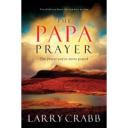
One of my projects concerns my prayer life. I’ve been reading a book by Larry Crabb called The PAPA Prayer. It’s a guide for approaching God on the basis of relationship rather than on the basis of petition (asking for stuff that I want to get). Crabb’s thesis is that if one makes it his primary purpose to relate to God in prayer, all the other stuff falls in place.

Relating to God, according to Crabb, takes the form of Presenting yourself to God, Attending to how you’re viewing God, Purging yourself of any obstacles to relationship with God, and Approaching God as your ‘first thing’ (thus the PAPA acrostic).

The last A in the acrostic was the source of a spiritual epiphany for me today. In short, I had to admit to God that he had not been my ‘first thing’ in a long time. Other things had taken God’s place: aspiration for success in ministry; desire for happiness in my marriage; concern for my own peace of mind and psychological well-being. If I’m honest, God has been the means of reaching all of those ends; God has not been the end. I’ve been missing the Provider for the provisions.

I can’t tell you how freeing it was to admit that to God, and to approach him again as my ‘first thing’.

City on a Hill

Charles Kiser —  October 30, 2007 — 13 Comments

sun2.jpgAt the end of September, Christ Journey and Sunrise churches—the two churches we’ve worked with in our apprenticeship period—partnered together in a weekend retreat called City on a Hill. The retreat is the second of two retreats we’ve developed (the first was Marvelous Light) for facilitating spiritual formation in followers of Jesus. This particular retreat focuses on equipping disciples to participate in the mission of God.

City on a Hill makes use of two components also found in Marvelous Light: teaching and ministry group. Teaching times on Friday night present a theological framework for the mission of God and obstacles that keep people from participating in mission. Saturday’s teaching includes seven practical tools for drawing others into the story of God: sharing God’s story, starting spiritual conversations, dealing with unbelievers’ doubts, sharing one’s own faith journey, service, the role of community in mission, and helping others enter the kingdom and continue in formation.

Ministry groups are the epicenter of formation at City on a Hill. These are groups of 2-3 people who journey together throughout the entire weekend to process and appropriate content from the teaching times. On Friday night, for instance, ministry groups share in confession and prayer about barriers to mission that exist in group members’ hearts. On Saturday, ministry groups provide a place to engage the practical tools offered for mission. For example, group members start spiritual conversations, share their faith stories, and communicate the story of God with each other.

At the end of the weekend several retreat participants filed forward to share how they’d been impacted by their experiences and to give a blessing to their fellow retreat members. One of the most encouraging testimonies came in an email from a Christ Journey member the week after City on a Hill:

I just had some great news to share. As most of you know, we have been having a Sunday night house church with our neighbors DiAnne and Alex. This has been great, but we have also been praying for our other neighbors a little further down. Their names are Earl and Nicky. This couple is somewhere in their mid to late 50’s. They came to the cookout and we talk to them quite regularly. They’ve come down to join us sitting on the front porch a couple of times, but not really showing that much interest.

A couple of weeks ago when I was finishing up on the roof, Earl came down and we talked for quite a while about a variety of subjects, but worshiping God and church was a pretty big topic during the discussion. Anyway, when we were done and I went back to working, I had thought that I’d blown it with Earl and Nicky because of opening my big, fat, arrogant mouth. I had intended to go down and talk to Earl about it, but hadn’t quite done it.

Anyway, last Sunday on our prayer request sheet, we had prayed that our house church would increase and that we would continue to see the Spirit’s work in our current house church members. Well, low and behold, last Sunday night, Earl and Nicky came to join us in worship and prayer and conversational discussion. Not only did they join us last Sunday, but they talked like they would start making it a regular deal to join us on Sunday nights.

So, PRAISE GOD for how His hands are working through us, even when we feel like we’ve really messed it up. This is definitely proof that you don’t have to have it all together for God to use you. Hey, just look at me, I’m probably as messed up as anyone can be and God is working anyway.

What an expression of Jesus’ words in Matthew, the same words that frame up the entire City on a Hill experience: “You are the light of the world. A city on a hill cannot be hidden. Neither do people light a lamp and put it under a bowl. Instead they put it on its stand, and it gives light to everyone in the house. In the same way, let your light shine before others, that they may see your good deeds and praise your Father in heaven.”