We had a Neighbor’s Lunch this weekend at Sonny Bryan’s Smokehouse in West End. I really love these experiences. About half of our group consisted of young adult/professionals; the other half consisted of poor neighbors.


I decided to walk around downtown for about a half-hour before lunch in the hopes that I might meet someone to invite to our lunch.

I just prayed as I walked that God would show me someone to serve, to befriend.

And yes, I had the nervous butterflies. I knew God would have to work in order to push me past my anxiety about cold-turkey invitations.

As I walked God brought a text to mind in Jesus’ teaching about inviting people to a party (Luke 14:12-14):

Then Jesus said to his host, “When you give a luncheon or dinner, do not invite your friends, your brothers or sisters, your relatives, or your rich neighbors; if you do, they may invite you back and so you will be repaid. But when you give a banquet, invite the poor, the crippled, the lame, the blind, and you will be blessed. Although they cannot repay you, you will be repaid at the resurrection of the righteous.”

At the very end of my walk I saw a man sitting on a bench with a Wal-Mart sack beside him. I walked by him, looked him in the eyes and said, “Hey, how’s it going?” He responded politely.

I kept walking.

Then I heard, “Excuse me sir. Do you mind if I ask you something?”

That was all I needed. Thank you, God.

He explained that he had just moved a few weeks ago from a large city in the north to find work in Dallas. He was on the streets, and he was trying to find a way to get to Wichita Falls because he knew someone who could give him work there. The bus fare cost $43. He showed me the $30 he had and asked if I could help.

I just happened to have $15 in my pocket.

I told him, “You know it’s funny that you ask because I’ve been walking around praying that God would show me someone to help.”

That resonated with him — he told me he was also a believer.

Paul ended up coming to lunch with us and eating all the ribs he could handle. After lunch, we sent him off with enough for bus fare to Wichita Falls. We hope to hear from him again when he’s back in Dallas.


I love divine appointments. It seems that God works out all the details when I merely make myself available to him.

At future lunches we’ll invite everyone to show up early and go out into the streets and alleys praying that God would lead us to new friends. In fact, why couldn’t we do that for all our events?


On Sunday night, we talked about immigration and its relationship to spirituality and politics. Go figure that three of our poor friends from our Neighbor’s lunch came—one of whom regularly protested on behalf of two imprisoned border patrol agents, another of whom was married to an undocumented immigrant! What an interesting conversation it was.

It was also amazing to see conversation between the rich and poor, the educated and less educated. I think we discovered commonalities between the two we would have never expected.

Seriously, where else in the world can the rich and poor rub shoulders like this? That’s the beauty of the church.

In the words of one of our young adult friends at the gathering, “I could feel the presence of God with us. It was beautiful.”

We discovered in scripture God’s openhandedness and mercy toward the “stranger” or immigrant, as well as the ways certain responsibility was expected of the immigrant—particularly when the immigrant was living among God’s people.

If you’re interested in a good book on the subject, I’d encourage you to pick up Christians at the Border by M. Daniel Carroll R. It’s a short read and a good introduction on how the scriptures speak to the topic of immigration.

What We’re About

Charles Kiser —  August 4, 2008 — 5 Comments

One of the products of the last several months of groundwork and planning has been the initial development of our identity as a church. Mission, vision, values — this is the language of identity.

To a certain extent, much of the groundwork we’ve done is tentative. As the church grows and comes to life more fully it will give body and character to much of the initial dreaming and articulation we’ve done. We’re prepared to adapt (adaptation, in fact, is part of our values set).

When I look at our values I think of time spent in the Mission Alive Strategy Lab nearly two years ago, hours spent in front of a whiteboard with Ryan, Claudia and Julie, searching the Scriptures, conversations with mentors, coaches and other church planters, and even asking our Dallas friends and neighbors what they thought. These values have been a community project.

What you’ll see below is our take on the whole mission/vision/values task. You’ll notice that it’s not much. Part of our bias in developing this kind of thing is that less is more. What is the use in crafting this language if it will sit in a document somewhere on our computers and never be used? We wanted our values to be simple and memorable. Our values sum up what we’re all about.

These values will be our roadmap for future decisions. They’ll be the way we organize our job descriptions as the staff grows. Even our children’s ministry will find its place living out these very same values.

Ultimately, all of our values flow out of the story of God as Father, Son and Spirit that we find in the Christian Scriptures.

You’ll notice that each heading is one of our major values; underneath the headings are sub-values, if you will, or further explanation as to how the major values come to life in our community. Accompanying each value is a short statement that brings the value down to earth. When people ask “What are you guys about?” we’ll say, “We’re people that live for something bigger than ourselves” or “Storyline is a church where you can make real friends.”

Here’s an excerpt from material published on the website (which will be fully up and running next week…hopefully that will be the next blog post!):

Storyline Christian Community lives to discover its place in God’s story through dependence on God, mission, life change and genuine relationships.

Dependence on God — God manages our lives better than we can.

  • Trust: The best way to live is in a trusting relationship with God

Mission — We live for something bigger than ourselves.

  • Reproduction: followers make new followers and churches make new churches
  • Hospitality: extending a warm welcome to strangers
  • Justice: befriending the poor; helping the helpless; caring for the earth
  • Adaptability: the courage to create new things and the willingness to adapt

Life Change — God is fixing us.

  • Character: thinking, acting and feeling like Jesus
  • Expression: reflecting God’s image with our unique gifts and abilities
  • Generosity: extending our resources — time, money, abilities — on behalf of others
  • Simplicity: finding more in less

Genuine Relationships — We make real friends.

  • Authenticity: being real about who I am with others
  • Acceptance: embracing people as they are without judgment
  • Collaboration: working together where everyone has something to contribute

What do you think? What do you like? What feedback would you give? Again, we’re all about adaptation.

Yesterday afternoon several of us served lunch to some of our neighbors at the Bridge, a new shelter that opened up in May for the chronically homeless in downtown Dallas. Click here for a few fast facts about the facility at the Metro Dallas Homeless Alliance website, the organization that runs the Bridge. Click here for an article and video from Dallas Morning News.

We worked in conjunction with First Presbyterian Church’s ministry, The Stewpot, which serves three meals every day for the homeless at the Bridge’s cafeteria, Second Chance Café.

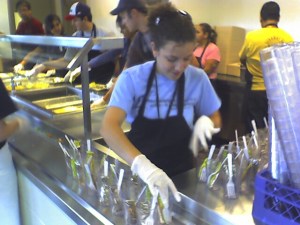
A few of us served our neighbors meals from the kitchen. Others of us filled/refilled water glasses for our neighbors at their tables.

It was a great experience — one we’ll probably begin doing regularly.

I was struck by the overwhelming number of people at the Bridge. The Café director told us the shelter was built for a capacity of 400, but sometimes hosted as many as 1,200. The facility has gotten so full that many people sleep in the courtyard area in the evenings.

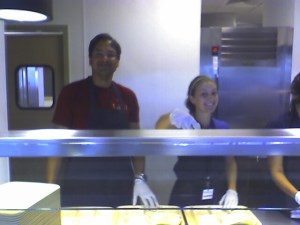
Raj and Lauren, two Storyline volunteers, commented about the diversity of the people they served. Young, old, Black, White, Latino, male, female—people of all different kinds were present. Homelessness affects a wide range of people.

I’m also struck by the way the Bridge seems to corral the homeless into a corner of the downtown area (the facility is located at one of the southern most points). Other organizations, like our friends at Soup Mobile, are no longer allowed to serve food downtown. Is it a subtle (or not-so-subtle) attempt to make the homeless less visible to the wealthy professionals who work and live downtown?

I know the issues are much more complicated than I’m aware. I’m just raising questions as an outsider.

One thing is certain: the Bridge is just a beginning step of a much larger process. Given the significant overcrowding at the Bridge, it’s clear that much more help is needed to serve the poor and homeless in downtown (which makes me wonder why other organizations are being asked to leave).

I talked to a 22 year-old woman just before we left. She had been on the streets since she was sixteen. She’d gotten pregnant and then lost the child after birth. I could see desperation in her eyes. When I asked her how she was doing she shot straight with me: not good. She couldn’t find a place that gave away sanitary pads and so she was left to bleed all over herself. I could tell she was humiliated. (I know this story is uncomfortable to read — but so is the reality of the streets, to say the least.)

Yesterday afternoon I found myself thanking God for a cooled home and a comfortable bed, and praying for my neighbors like that young woman who were at that very moment sitting out in the sweltering heat.

You don’t walk away from these kinds of experiences the same person.

May justice flow through Dallas like a river.

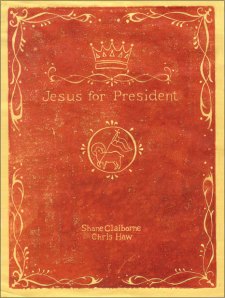
I began my reading on politics and spirituality last week with Jesus for President, by Shane Claiborne and Chris Haw. One section I appreciated in Jesus for President (JFP) was a comparison of the language used of/by the Roman Empire and the language of Jesus’ conversations. It opens a window into the political nature of Christianity.


The way of Jesus is not just religious; it is also political. In fact, such a distinction was unfamiliar in first century culture: “Divinity and politics [weren’t] two separate things to be combined but…were, to a great extent, the same thing” (JFP, 67).


For instance (adapted from JFP, 67-69):

  • Basilea (“empire” or “kingdom”): a term used for the Roman Empire, ruled by Caesar. It was also Jesus’ most common subject of preaching—the kingdom of God, ruled by Yahweh, the one who delivered Israel from Egypt.
  • Gospel (evangelion: “good news”): in the Empire, “an imperial pronouncement, usually accompanied by flags and political ceremony, that an heir to the empire’s throne had been born or that a distant battle had been won”; for Jesus, this was the good news of the kingdom of God.
  • Son of God: A common title for kings and emperors, like Alexander the Great and Octavian (or Augustus, in the lineage of Julius Caesar); also a name given to Jesus in the New Testament.
  • Ekklesia: “A local public assembly within the greater Roman Empire, much like a town meeting. These assemblies bestowed citizenship, discussed local political concerns, assigned ‘elders,’ and offered prayer and worship to Caesar. There was no separation of religion (cultic sacrifices, etc.) and secular political business”; also the word used for the early church (translated “church”). The early church “bestowed alternative citizenship and assigned elders. Though it discussed its own political and religious concerns, it was understood as separate from, and in contrast to, the state and the other ekklesiai, their politics, and their religion.”
  • Savior: “Caesar Augustus, as Savior, was seen as the one who healed the chaos of Rome and brought it into a new golden age”; also a common title for Jesus in the New Testament.
  • Faith: “A term used for trust in, allegiance to, and hope in the Pax Romana”; also “a term used for trust in, allegiance to, and hope in Jesus.”

Consider also the language of an inscription found at the ruins of a government building in Asia Minor, dated 6 BC — the resemblance to the language of Jesus and the early church is striking (shown in JFP, 70):

The most divine Caesar…we should consider equal to the Beginning of all things…for when everything was falling (into disorder) and tending toward dissolution, he restored it once more and gave the whole world a new aura; Caesar…the common good Fortune of all…the beginning of life and vitality…all the cities unanimously adopt the birthday of the divine Caesar as the new beginning of the year…Whereas the Providence which has regulated our whole existence…has brought our life to the climax of perfection in giving to us (the emperor) Augustus…who being sent to us and our descendants as Savior, has put an end to war and has set all things in order; and (whereas,) having become (god) manifest (phaneis), Caesar has fulfilled all the hopes of earlier times…the birthday of the god (Augustus) has been for the whole world the beginning of good news (evangelion=gospel!) concerning him….

Fascinating. Jesus adopted familiar, politically-charged language from the prevailing cultural warehouse of the day as a way of describing who he was and what he was about. It must mean that the message of Jesus was/is inherently political. Jesus spoke of a kingdom that challenged the kingdoms of humanity.


So the question is not, “Is Christianity political?” Rather, the question is, “How is Christianity political?”


How would you answer this question?


Is it possible that Christianity is political in a way drastically different than the American political system?

The Kiser family vacation was awesome. If you missed the story on vacation, see the previous post below.

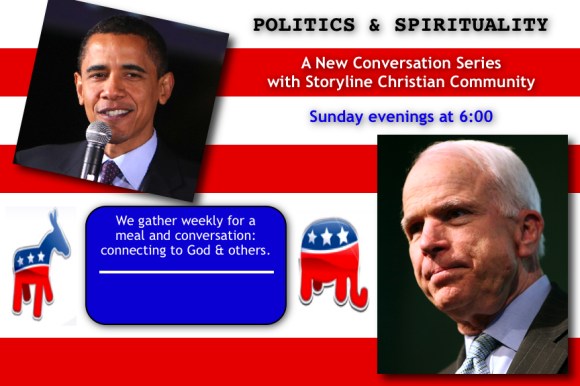
This weekend in our house church gatherings we’re starting a new series of conversations centered on the intersection of politics and spirituality. The topic is particularly appropriate given the election year and the inevitable changes that are coming as a result.

This conversation on politics is a growth point for me. For years I have not cared much about politics. I’m turned off by partisan bickering. I’ve always been quite confused as to what part I should play given that my primary citizenship is in the kingdom of God.

To tell you the truth, American politics has had very little to do with my personal spiritual formation. I didn’t grow up listening to many sermons on the matter. If anything, the underlying rhetoric at (some) churches and schools I attended was that if you were a Christian, you were also a Republican.

I’m no longer comfortable with such rhetoric.

The purpose of our conversations is to help us to think reflectively and critically about what it might look like for us to participate (or not) in the political process as followers of Jesus. I really have no idea where we’ll come out. I doubt that our conversation will end up in support of one particular party or another (because both miss the mark), but rather with a new orientation toward how Christians might relate to the system as a whole.

Part of my interest in this subject is fueled by the recent realization that politics is a religion of sorts for many of my non-Christian friends in Dallas.

At a recent World Affairs Council event, I talked with one guy who had worked with a senator in Washington, D.C. for several years and is currently working for a congressman in Arlington.

When I asked him why he got into politics he said, “Because I’m excited about the way politics can change the way things are.”

His answer is strikingly similar to the reason I got into ministry and church starting — I want to help change the world, too.

Here are a few of the books I’ll be reading throughout the course of our conversations in the next several weeks:

  • Everything Must Change: Jesus, Global Crises and a Revolution of Hope, Brian McLaren (2007)
  • God’s Politics: Why the Right Gets it Wrong and the Left Doesn’t Get It, Jim Wallis (2005)
  • Jesus for President: Politics for Ordinary Radicals, Shane Claiborne [2008]
  • The Politics of Jesus, John Howard Yoder (2d ed., 1994)

What books have you read that have been helpful to you on this subject? How have you learned to integrate faith and politics? Please chime in.