Archives For November 30, 1999

Changing Names

Charles Kiser —  October 25, 2011 — 4 Comments

Julie read me a beautiful news story a few nights ago about how a health officer in Maharashtra, India, Dr. Bhagwan Pawar, set out to help girls change their names.

Dr. Pawar conducted a survey in his district and discovered that 222 girls had been named “Nakusa,” a Marathi word which means “unwanted” in English.

In an interview with India Real Time, Dr. Pawar said: “In most cases, after the birth of two or more female children, the next one would be named ‘Nakusa’ by the parents.”

Indian culture places high value on male children, so much so that hospitals are legally forbidden to reveal the sex of the child before birth in hopes of preventing gender selective abortions, according to an Associated Press article.

This same article goes on to point out that male children are preferred to females partly because it’s very expensive to give girls away in marriage. Families often go into debt to provide a dowry at their daughter’s wedding, whereas a boy brings a bride and her dowry back to the family.

So people like Dr. Pawar and his team are conducting renaming ceremonies to change girls’ names from “unwanted” to names like “Vaishali” that mean “prosperous, beautiful and good.”

Can you imagine what it would be like to be named “Unwanted” by your parents?

Imagine hearing the roll called at school, and your name came up every day as “Undesirable.” “Leftover.” “Wish-you-were-a-boy.” “Unloved.”

What an incredible act of justice to let the girls take on new names!

This story reminded me of a story in Hosea 1-2, where the prophet Hosea, under God’s instruction, names his children “Lo-Ruhama” (which means “not loved”) and “Lo-Ammi” (which means “not my people”). Their names were to be a message to the people of Israel that God was upset with them for their disobedience and idolatry. God wanted desperately for Israel to return to him.

And then, in a wonderful act of grace (because Israel, after all, deserved to be called the names given to Hosea’s children – while Hosea’s children and the Indian girls did not), God says (Hosea 2:16-23):

16 “In that day,” declares the LORD,
“you will call me ‘my husband’;
you will no longer call me ‘my master.’
17 I will remove the names of the Baals from her lips;
no longer will their names be invoked.
18 In that day I will make a covenant for them
with the beasts of the field, the birds in the sky
and the creatures that move along the ground.
Bow and sword and battle
I will abolish from the land,
so that all may lie down in safety.
19 I will betroth you to me forever;
I will betroth you in righteousness and justice,
in love and compassion.
20 I will betroth you in faithfulness,
and you will acknowledge the LORD.

21 “In that day I will respond,”
declares the LORD—
“I will respond to the skies,
and they will respond to the earth;
22 and the earth will respond to the grain,
the new wine and the olive oil,
and they will respond to Jezreel.
23 I will plant her for myself in the land;
I will show my love to the one I called ‘Not my loved one.’
I will say to those called ‘Not my people,’ ‘You are my people’;
   and they will say, ‘You are my God.’

Dr. Pawar and his team reflect the love and justice of God in their renaming work.

Guilt. Obligation. A sense of duty. A feeling within that it’s just what Christians are supposed to do. Curiosity. Desperation. Guidance.

All of these answers surfaced in response to this question in our Community Gathering conversation on Sunday.

I attended a Christian liberal arts university where students were encouraged to read through the entire Bible in a year. As incentive for staying the course, those who completed their reading were offered a free steak dinner at the President’s house.

I know the intentions for this approach were noble. The leaders of the University hoped that by reading the vast content of the Bible, students would know more about God and would grow in their relationship with God.

I’m afraid, however, that there are unintended consequences to such an approach to the Bible. I know because I fell victim to them.

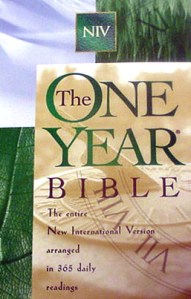
Though I never took the President up on his offer, I did decide to read through the Bible the year after I graduated. I bought a One Year Bible, which has daily readings from the Old and New Testament, and decided to make my way through it.

By the summertime, I had fallen about a month behind. I felt terrible about it. I was reminded of my shortcomings every day when I read the dates that accompanied the daily readings in the One Year Bible.

So on my summer vacation (in Destin, Florida!) I spent most of the time trying to catch up. I had to stay the course. I didn’t want to be a failure at Bible reading. I must have read hundreds of chapters of Scripture that week.

Here’s the thing: I don’t recall connecting to God in a significant way during that week. I can’t remember anything about it except that I was so caught up in catching up.

What this revealed to me is that it’s possible to read the Bible and yet miss the God of the Bible.

I was caught up in a paradigm for Bible reading that revolved around completion, information, and volume.

The side effects were:

  • guilt
  • failure
  • boredom
  • setting up those who read the most Bible as an elite class of people
  • and most significantly, missing God.

Jesus critiqued a similar impulse in the religious leaders of his day when he pointed out that they went to the Scriptures to find eternal life but missed that the Scriptures testified about Jesus and thus refused to receive eternal life from him (John 5:39-40). They read the Bible but missed the God of the Bible.

In the John 5 story, Jesus simultaneously points to a different paradigm for Bible reading, one that revolves instead around connection, relationship, communication, and interaction. The Bible serves as a witness that introduces us to God. The Bible is a conversation piece through which we interact with God.

What would it look like to read the Bible in such a paradigm?

  • We’d read less. But we’d read enough to get the gist of a story, text or thought, but no so much that we weren’t able to slow down and listen to God through it. Certainly there are seasons where it’s necessary to read a greater volume of Scripture (e.g., seminary), but even then it’s critical to translate the learning into conversation with God.
  • We’d attend to “heart tugs”. We’d pay attention to verses or phrases that prick our hearts, convict us, comfort us, or challenge us and we’d reflect on them in silence.
  • We’d interact with God about it. We would spend most of our time in dialogue with God about what we’re reading – listening for how we need to grow and change, or sitting peacefully in his presence with the knowledge of who he is.
  • We’d return to those Scriptures again and again. There’s no need to return to passages we’ve read in the completion paradigm – because we’ve completed them! But in a connection paradigm, we can return to them again and again with God to let him form us and shape us.

Dallas Willard says:

Do not try to read a great deal [of Scripture] at once. As Madam Guyon wisely counsels, ‘If you read quickly, it will benefit you little. You will be like a bee that merely skims the surface of the flower. Instead, in this new way of reading with prayer, you must become as the bee who penetrates into the depths of the flower. You plunge deeply within to remove its deepest nectar.’ …It is better in one year to have 10 good verses transferred into the substance of our lives than to have every word of the Bible flash before our eyes.

This kind of Bible reading is far from boring or guilt-inducing. Encountering God through Scripture will keep you coming back again and again.

How does this analysis compare to your own experiences? What motivates you to read the Bible?

The Deep Ground

Charles Kiser —  October 4, 2011 — 3 Comments

I had an insightful conversation recently with Randy Harris about the spiritual life.

Randy, giving credit to the work of Martin Laird in Into the Silent Land, described three postures of discipleship.

“The first operates from up here,” Randy said, moving his hand up by his head. “Here we work out of our brilliance, out of our giftedness, out of our understandings.”

I suspect that most young people (twentysomethings down) take this posture in life and discipleship. Perhaps this suspicion is rooted in my own admission that I’ve lived most of my life out of this posture – and, as you’ll see, it’s nothing to be proud of.

“The second [posture] operates from here,” moving his hand back and forth further down by his chest. “Here we work out of a keen awareness of our own brokenness, our limitations, our struggles and turmoil.”

In the past few years habitual patterns of sin (like anger, pride and lust) moved me to this posture of discipleship. It reminds me of the words of a graduate school professor who said that we twentysomething seminarians needed a few more years of struggling with sin so that we could recognize the depth of humanity’s brokenness (and our own).

“There’s a third way that operates from here, ” Randy said as he moved his hand down by his waist in the chair he was sitting in. “We hardly have language to describe this place. So few find it. It is the deep ground of God.”

“What exactly is this deep ground?” I asked.

“It’s God. It’s God in us. It’s your true self. It’s the Holy Spirit. It’s silence. It’s the place where you stare down your brokenness in silence and tell it to back off. It’s the Center.”

He’s right – I’m not sure even how to describe it. But I think it’s the place where we discover God. Where we encounter God. And after the encounter, where we sit in deep peace.

I’ve only touched the edge of the deep ground’s garment in my life – if that.

The key, Randy says, is to find the deep ground of God in contemplation (silence) and then begin to live out of it in every moment of our daily lives. That journey lasts a lifetime.

Laird adds that “union with God not something we are trying to acquire; God is already the ground of our being.” The real issue in finding the deep ground is to realize that “we live, move and have our being in God” – that we, in fact, are already rooted in the deep ground, though not consciously aware of it.

The extent to which we realize we are rooted is God is the extent to which we live out of the deep ground. Such realization is the work of contemplation and silence.

I’m eager to find this deep ground. It’s exciting to think that the deep ground is as deep as God is big, and that I can spend the rest of my life exploring it.

What about you? In what ways do you identify with these three postures of discipleship? Which posture are you currently living out of?

Mike Breen and Steve Cockram, in their book Building a Discipling Culture, describe two fundamental elements of the way Jesus made disciples.

1. Invitation. Jesus was inviting and supportive of his followers. They knew he loved them. They knew he believed in him. He affirms and blesses Peter when Peter acknowledges that he is the Messiah.

2. Challenge. Jesus does not expect that his disciples will stay where they are. He expects them to grow. He calls them out on their B.S. He challenges them. He loves them too much to allow them to stay the same. Jesus calls Peter out – saying “Get behind me Satan!” – when Peter attempts to rebuke him about submitting to death at the hands of religious and political leaders.

Both of these elements are essential to leadership. Breen and Cockram submit that discipleship is subverted when one or both is missing.

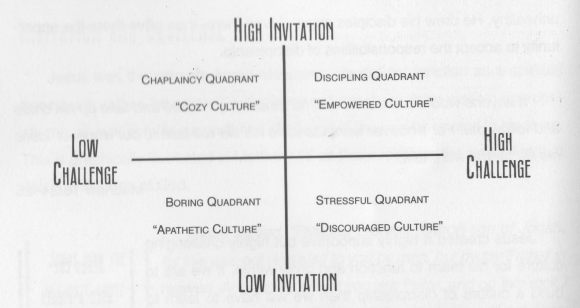
Invitation without challenge produces a cruise-ship, chaplain culture. Sin and brokenness hang around without confrontation. Participants fail to make deeper commitments to spiritual growth. “Come just as you are (and stay there).”

Challenge without invitation produces a stressful, discouraging culture. “What we’re doing is not good enough!” “We need to do more!” Participants begin to wonder if the people leading see them as anything more than a means to accomplish an end.

Lack of both invitation and challenge produces apathy. “Who cares? We don’t.”

The sweet spot in leadership and discipleship is a combination of both invitation and challenge. 3DM calls this “Empowered Culture.” “God loves you and so do I” is heard right alongside “God wants more from us; he is calling us deeper.”

It’s a culture in which the role of prophet (challenge) and pastor (invitation) co-exist together in unity.

From Building a Discipling Culture by Breen and Cockram, p. 12

Moment of confession. About two years into our church planting work with Storyline, I realized the culture we had created was High Invitation / Low Challenge – the “Chaplaincy Quadrant.”

In an effort to reach out to our broader community in a non-judgmental way, we avoided most talk of commitment and challenge. Those who seemed particularly interested we invited deeper into community and leadership, but even then without a foundation from which to challenge and “hold their feet to the fire” of spiritual growth. We lacked any sort of communal sense of covenant. We failed to develop a way for participants even to give permission to be challenged in their walk with Jesus.

My leadership coaching was also mostly invitation and seldom challenge. If I could sum up my coaching posture: “Whatever you want to do, I’ll support you and equip you in it. If you don’t want to do it, that’s fine, too.”

The results: We began to spin our wheels in mission. A relatively small number of people were actively living out the lifestyle of Jesus. Some not-yet Christians in our community stalled out in their journey toward Jesus. Hospitality and justice work began to sputter.

These results set us on a journey to learn how to form a culture that had a place for both invitation and challenge. We’re now moving – even if gradually – from the cozy culture to the empowered culture. Our newly developed communal lifestyle and coaching groups are the best examples of our movement in this direction.

My coaching posture is evolving into: “What is God saying to you? What are you going to do about it? Go do it!” And if necessary: “Why haven’t you done it?” Breen and Cockram describe it as an environment of “high accountability and low control.”

It’s often assumed that a “Culture of Grace” is devoid of challenge. Such an assumption is a seed of the consumer-Christianity mess in which we find ourselves.  Paul says “we work out our salvation with fear and trembling as God works in us” (Philippians 2:12-13) and that “the grace of God teaches us to say ‘no’ to ungodliness….” (Titus 2:12). Grace is inherently challenging. The grace of God challenges us to respond to it, not in ways that seek to earn favor with God, but in ways that honor the gift that has been given.

What about you? Which quadrant best describes your church culture? Your leadership?

6 Ways to Tune into God

Charles Kiser —  September 13, 2011 — 2 Comments
  • Breathe deeply. Practice a breath prayer where you inhale God’s grace and exhale your brokenness and disappointments. The most famous breath prayer is called the Jesus Prayer: “[inhale] Lord Jesus Christ, Son of God, [exhale] have mercy on me a sinner.”
  • Write down your tasks. Sometimes we’re distracted by what we need to do – we’re afraid that if we take our minds off of it, we’ll forget to do it. So write it down – come back to it after you’ve tuned into God. God may just tune you in to what you need to do in a deeper way.
  • Create a mental picture. One of my favorite practices is to imagine what Jesus looks like and myself there with him. Talking to him. Listening to him.
  • Read a short passage from Scripture. Use the “read until” approach: read until something hooks you, resonates with you, speaks to you. You may not get past the first verse – and that’s okay! It’s not a Bible reading contest!
  • Sing or listen to music. Music has a way of centering us, especially repetitive choruses that focus on God.
  • Do something else. Most people have a hard time slowing their minds and hearts down while sitting still. So do something with which you have “subconscious competence” – something automatic – like driving, gardening, or exercising. Tune into God while doing something that keeps your body busy. Some of my best moments with God are on the treadmill.

Inspired by How to Hear God’s Voice by Mark & Patti Virkler.